Flags that look almost the same, and how to tell them apart
Chad and Romania are basically the same flag. Here are eight pairs like that, and the one detail that gives each one away.
Chad and Romania are the same flag. Okay, not exactly, but close enough that nobody should feel bad about getting them wrong. Most national flags are built out of the same handful of ingredients (two or three stripes, a cross, a star, a coat of arms), and with nearly two hundred countries picking from that short list, some pairs were always going to end up almost identical. These are eight pairs that are easy to mix up in Flag Quiz and Flag Peek, and the detail that separates each of them.
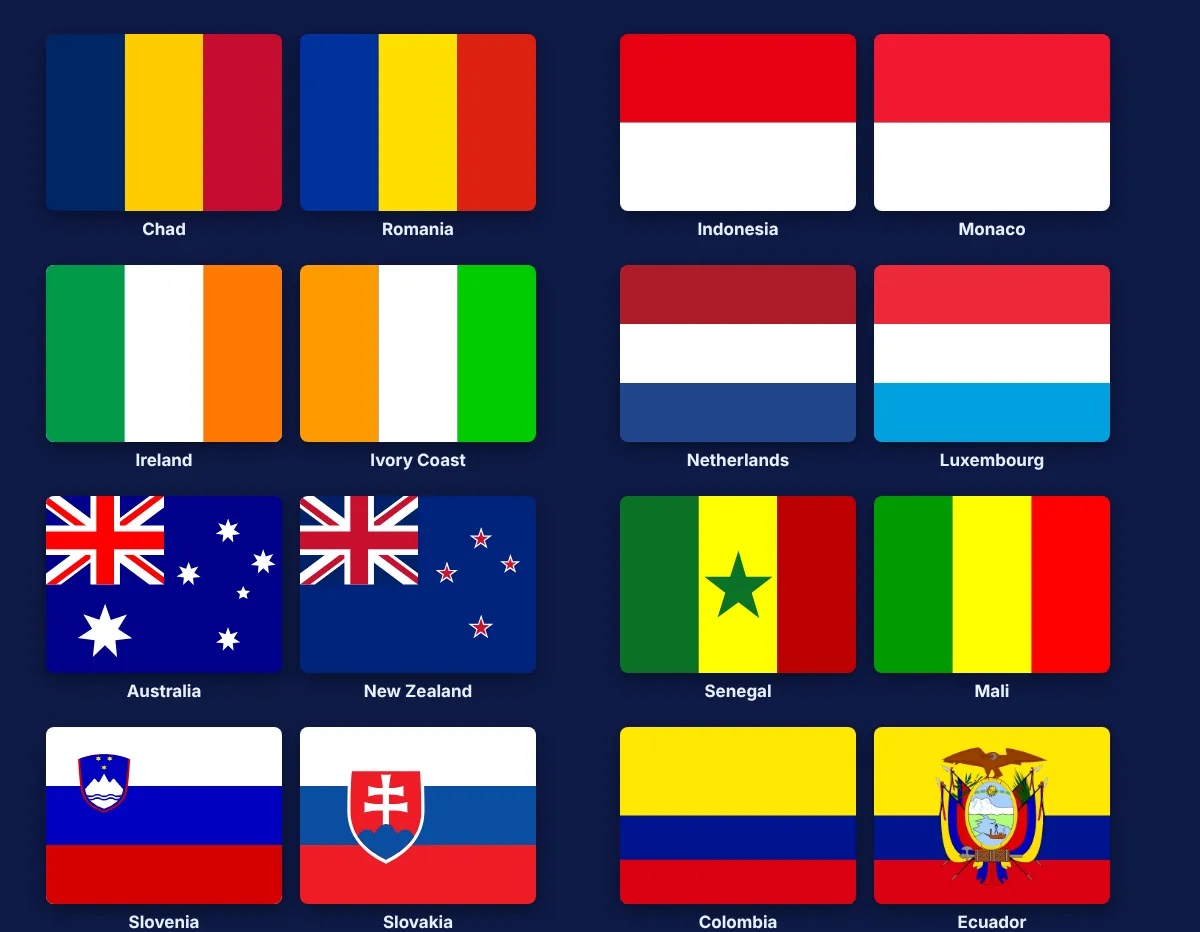
Chad and Romania, the really hard one
Blue, yellow and red, three vertical stripes, same order. And they weren't designed together: Romania's tricolour goes back to the 19th century, and Chad adopted its flag in 1959. They just ended up effectively the same. Chad's first idea was green, yellow and red, but it switched to blue because the Mali Federation already had a similar tricolour. Romania's flag still carried a communist coat of arms until the 1989 revolution, when people tore it out of the middle, and that's when the two became twins. When Romanian media later reported that Chad might raise the issue at the UN, President Ion Iliescu said Romania would not give up its tricolour. The only real difference is the blue. Chad's is a deep indigo, Romania's is a brighter cobalt. Side by side you can spot the darker blue pretty easily. On its own, though? Honestly I think this is one of the hardest calls in any flag quiz, and there's no shame in missing it.
Tell them apart: a blue that looks almost navy is Chad.
Indonesia and Monaco
Red over white, two equal horizontal bands. Officially the difference is the shape: Indonesia's flag is 2:3 and Monaco's is 4:5, so Monaco's is noticeably squarer. Both designs are old, too. Monaco's red and white are the heraldic colours of the Grimaldi family, fixed by a law of 1881, and Indonesia's red-and-white flag was raised at its declaration of independence in 1945. According to Britannica the resemblance is purely coincidental.
Here's the annoying part. Globely draws every flag at the same shape, so that clue just disappears in the game, and what's left is a slightly deeper red on Indonesia's flag. Which is not a lot to go on. And if you see the same two colours the other way up, white above red, that's Poland.
Tell them apart: a squarer flag is Monaco; white on top is Poland.
Ireland and Ivory Coast
Green, white and orange in vertical stripes, but in opposite orders. Ireland puts green next to the flagpole, Ivory Coast (Côte d'Ivoire) puts orange there. The Irish government's own guidance spells it out: green goes next to the flagstaff, and the white in the middle stands for a lasting truce between the Orange and the Green. That's the whole trick, and once you know to look at the pole side I'd say this is the easiest pair on the list. Italy also starts with green but ends in red, and India's saffron, white and green run across the flag, not down it, so those two shouldn't catch you out.
Tell them apart: green at the pole is Ireland; orange at the pole is Ivory Coast.
Netherlands and Luxembourg
Red, white and blue in horizontal bands, same order again. Luxembourg's blue is a light sky blue and its flag is longer, while the Netherlands uses a darker cobalt blue. So it's a shade thing, like Chad and Romania. Luxembourg's official booklet on national symbols says as much: its sky blue is what keeps it apart from the ultramarine Dutch flag. The same three colours show up on plenty of other flags too: Russia uses them in a different order (white, blue, red from the top), Croatia adds its red and white checkerboard shield, and Paraguay's red, white and blue has a round emblem in the middle.
Tell them apart: sky blue is Luxembourg; deep blue is the Netherlands.
Australia and New Zealand
Both are dark blue, with the British Union Jack in the top corner and stars of the Southern Cross on the right. Australia's stars are white, and there are six of them: five for the Southern Cross plus a large seven-pointed star under the Union Jack. New Zealand has four stars, red with white borders. You could count the stars, but checking their colour is way faster, so that's what I'd do. New Zealand nearly fixed this for everyone in 2016, but 56.6% voted to keep the flag over a silver fern design. What the stars mean is in the stars guide.
Tell them apart: red stars are New Zealand; a big white star under the Union Jack is Australia.
Senegal and Mali
Green, yellow and red vertical stripes. Senegal adds a green five-pointed star in the middle stripe, and Mali's flag is plain. The resemblance isn't an accident, either. For a short time in 1959 and 1960 the two were joined in the Mali Federation, whose flag used the same colours, and I kind of like that you can still see it. The federation's flag had a black human figure in the middle; Senegal swapped it for a green star in 1960, and Mali dropped it in 1961. Guinea uses the same three colours in reverse (red, yellow, green), and Cameroon puts red in the middle with a yellow star.
Tell them apart: a star is Senegal; no star is Mali.
Slovenia and Slovakia (and Russia)
White, blue and red in horizontal bands. Russia's flag is just the stripes. Slovenia adds a small coat of arms in the upper corner near the pole: the white peaks of Mount Triglav on blue, with three gold stars above. Slovakia adds a larger shield, lower down, with a white double cross on red standing on three blue hills. Both were added to stop the confusion: Slovakia's shield went on in September 1992 so it wouldn't match Russia, and Slovenia's arms were meant to separate it from both. The names being almost the same doesn't help at all, so I'd forget about the names and just look for the mountain.
Tell them apart: a mountain and stars, high up, is Slovenia; a red shield with a white cross is Slovakia.
Colombia and Ecuador (and Venezuela)
Yellow, blue and red. Colombia and Ecuador both give yellow the top half of the flag, with blue and red sharing the rest, and Ecuador adds its coat of arms, with a condor, in the centre. Venezuela's three stripes are equal, with an arc of eight white stars in the blue. They look like family because they kind of are: all three descend from the flag of Gran Colombia, the state that united them from 1819 to 1831.
Tell them apart: a coat of arms is Ecuador; stars are Venezuela; plain is Colombia.
My rule for any lookalike
When two flags share their stripes, check three things in this order: the order of the colours starting from the pole, the exact shades, and then any small emblem. In Flag Peek the order matters even more, because the plain stripes get uncovered first and the emblem is usually the last tile to lift. So don't sit around waiting for the emblem if the stripes have already ruled one of the pair out.
Sources
- Globely's game data (the flag artwork used in Flag Quiz and Flag Peek)
- Britannica: Flag of Chad
- Britannica: Flag of Romania
- The Scotsman: Call to UN as Chad and Romania keep same flag flying
- Britannica: Flag of Monaco
- Britannica: Flag of Indonesia
- Government of Ireland, Department of the Taoiseach: The National Flag
- Government of Luxembourg: À propos des symboles de l'État et de la Nation (PDF)
- New Zealand Electoral Commission: 2016 flag referendum results
- Britannica: Flag of Senegal
- Britannica: Flag of Mali
- Britannica: Flag of Slovakia
- Britannica: Flag of Slovenia
The games in this guide
 GameFlag Quiz: how to playRules, scoring and tips.
 GameFlag Peek: how to playRules, scoring and tips.
More guides
 Flags · 5 min readThe colours of the world's flags, measuredI measured every flag in Globely. Red is on three in four.
 Maps · 6 min readWhy some countries look too big on most mapsGreenland looks as big as Africa on a classroom map. Africa is fourteen times bigger.
 Maps · 6 min readThe world's smallest countries, and how to find them on a mapSeven countries are too small to draw on Globely's map. Where they are, and how to spot them.