What the stars on flags actually mean
About a third of the world's flags have at least one star, and almost all of them are counting something or pointing at something.
Stars are everywhere
Going through every flag in Globely, I counted 68 with at least one star, if you include the tiny stars inside some coats of arms (Croatia, Slovenia, Paraguay). That's 68 of the game's 197 flags, so about a third of all the flags in the world. And almost every one of them has a reason behind the number. Here are the ones I think are the most interesting.
Stars that are just counting things
The easy kind. The number of stars is the number of states, islands or provinces.
- United States: 50 stars for 50 states. The current version has been flown since 4 July 1960, the first Fourth of July after Hawaii joined. The 13 stripes are the original colonies. Adding a star for every new state is why the 50-star design is the 27th version of the flag.
- Micronesia: 4 stars for its 4 states, Yap, Chuuk, Pohnpei and Kosrae. The old Trust Territory flag had six stars, but Palau, the Marshall Islands and the Northern Marianas went their own way.
- Cape Verde: 10 stars in a circle, one for each of its main islands. They're yellow, and the flag only dates from 1992.
- Tuvalu: 9 stars for its islands, laid out like a little map. The funny part is that the name Tuvalu means something like "eight standing together". And a 1995 redesign really did have eight stars, until the original came back in 1997.
- Venezuela: 8 stars. Seven for the provinces that signed the independence declaration in 1811, plus an eighth added in 2006 for the province of Guayana. So if you remember Venezuela with 7 stars, you're not crazy, your memory is just out of date. The new star was added to honour a wish of Simón Bolívar.
- Philippines: 3 stars for the three main island groups, Luzon, Visayas and Mindanao. Plus a sun with 8 rays for the first 8 provinces that rose up against Spain.
So who has the most?
If you only count the main design and leave out the tiny stars inside coats of arms, the top of the list looks like this:
| Flag | Stars | What they stand for |
|---|---|---|
| United States | 50 | The 50 states |
| Brazil | 27 | The 26 states and the Federal District |
| Uzbekistan | 12 | The months and the signs of the zodiac |
| Cape Verde | 10 | The main islands |
| Dominica | 10 | The parishes |
| Bosnia and Herzegovina | 9 | A row that never ends (two are cut in half) |
| Tuvalu | 9 | The islands |
| Venezuela | 8 | The old provinces, plus Guayana |
Uzbekistan is the one people forget, and Dominica's green stars around a parrot are the other surprise.
Brazil, which is the best one (I'm not taking questions)
Brazil's flag has 27 stars: one for each of the 26 states, plus one for the Federal District. But they're not placed randomly. The blue circle is the sky over Rio de Janeiro on the morning of 15 November 1889, the day Brazil became a republic. The stars are real constellations, including the Southern Cross.
The law is even more precise than that. Brazil's flag law of 1971 fixes the moment at 8:30 in the morning and says the sky is shown as it would look from outside the celestial sphere. So it's a mirror image of what anyone in Rio saw looking up, which I find kind of beautiful and kind of hilarious.
And the single star above the white band is Spica, which stands for the state of Pará. It's on top because Pará is the state with the most land north of the equator. The current version dates from 1992. Nobody needed to put this much thought into a flag, and I love that they did.
Stars that point at the sky
- Australia has the Southern Cross on the right, and a big seven-pointed star under the Union Jack. Six points for the six states and one for the territories. The star only had six points when the flag was first flown in 1901; the seventh came in 1908.
- New Zealand also has the Southern Cross, but with 4 red stars instead of 5 white ones. If you mix up these two flags (everyone does) check the colour of the stars. Red stars, New Zealand. More on this pair in the lookalikes guide.
Stars about politics
China has one big yellow star for the Communist Party and four small ones around it for the classes of the people. When the flag was first raised in 1949, those were the workers, the peasants, the petty bourgeoisie and the "patriotic capitalists". The small stars all point at the big one, which is a nice detail if you look closely.
Vietnam has a single yellow star on red. Its five points are usually explained as the main groups in society, like workers, farmers and soldiers.
Panama has two stars, one blue and one red. The colours come from the two big political parties of the time, and putting both on the same flag was about keeping the peace between them. Red was the Liberals and blue the Conservatives.
Honduras has five blue stars for the five countries of the old Federal Republic of Central America: Guatemala, El Salvador, Honduras, Nicaragua and Costa Rica. It's basically a flag that still hopes they'll get back together someday. The stars were added in 1866, almost thirty years after Honduras left the federation.
One star, a lot of meaning
- Ghana's black star stands for African freedom. Ghana was one of the first African countries to win independence, in 1957 (on 6 March), and the national football team is literally called the Black Stars.
- Chile and Cuba both have a lone white star, and both call it "la estrella solitaria". Different countries, same nickname.
- Somalia's white star has five points for the five areas where Somali people live, not all of which are inside Somalia. The light blue came from the UN flag.
- Israel has the Star of David, a six-pointed star, which makes it one of the few flags where the star isn't five-pointed.
And one flag where the stars never end
Bosnia and Herzegovina has a row of white stars running down the diagonal. The top and bottom stars are cut off by the edge of the flag, and that's on purpose: it's supposed to look like the line of stars keeps going forever. The stars and the blue come from the flag of Europe. It was imposed in 1998 by the international High Representative after local politicians couldn't agree on one.
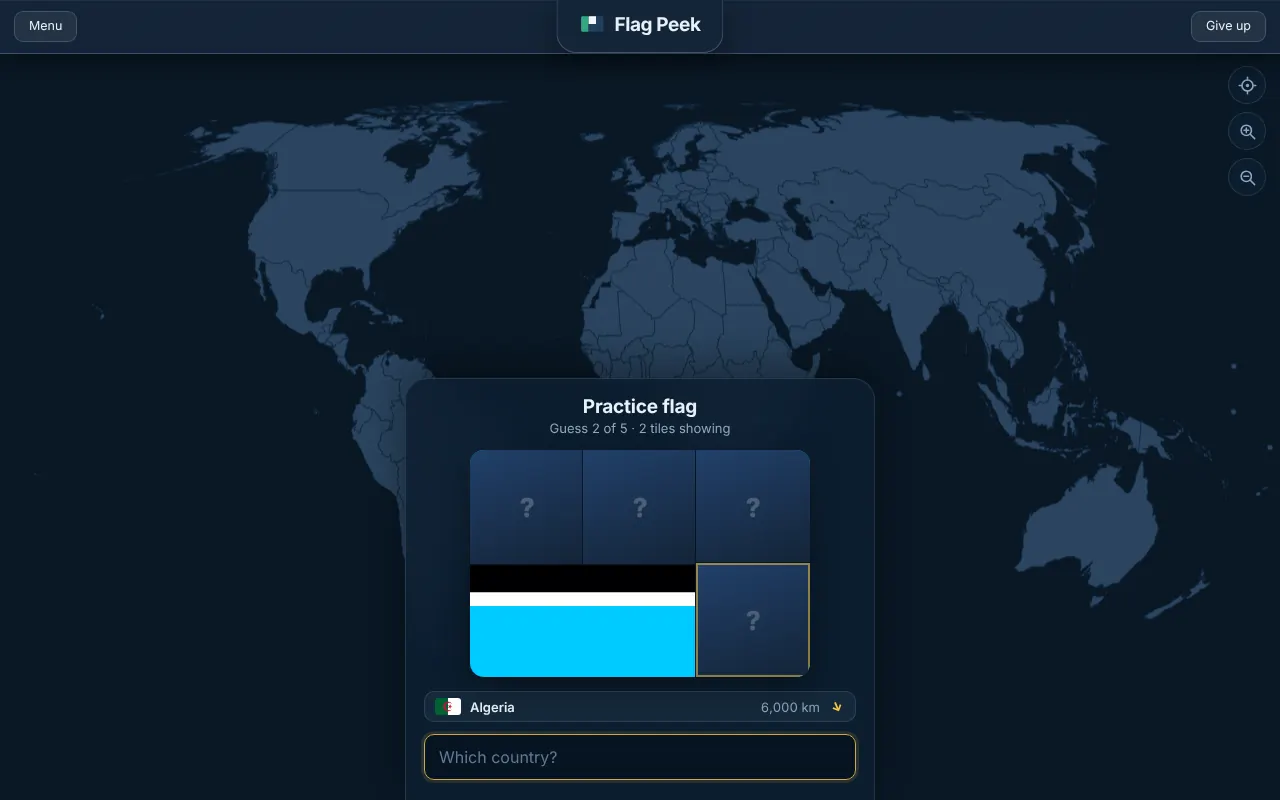
Tip for the games: in Flag Peek, a tile with a star is a much better clue than a tile of plain red. Only a third of flags have a star, and once you see its colour (white, yellow, red, black) the list gets short fast. A black star narrows it to Ghana, Guinea-Bissau or São Tomé and Príncipe.
One catch: Flag Peek lifts the plainest tiles first and saves the most detailed one for last, so on most flags the star is the final reveal. Five tiles of plain stripes don't rule out a star under the sixth. And a star on an early tile probably means stars in more than one place, like Bosnia's diagonal.
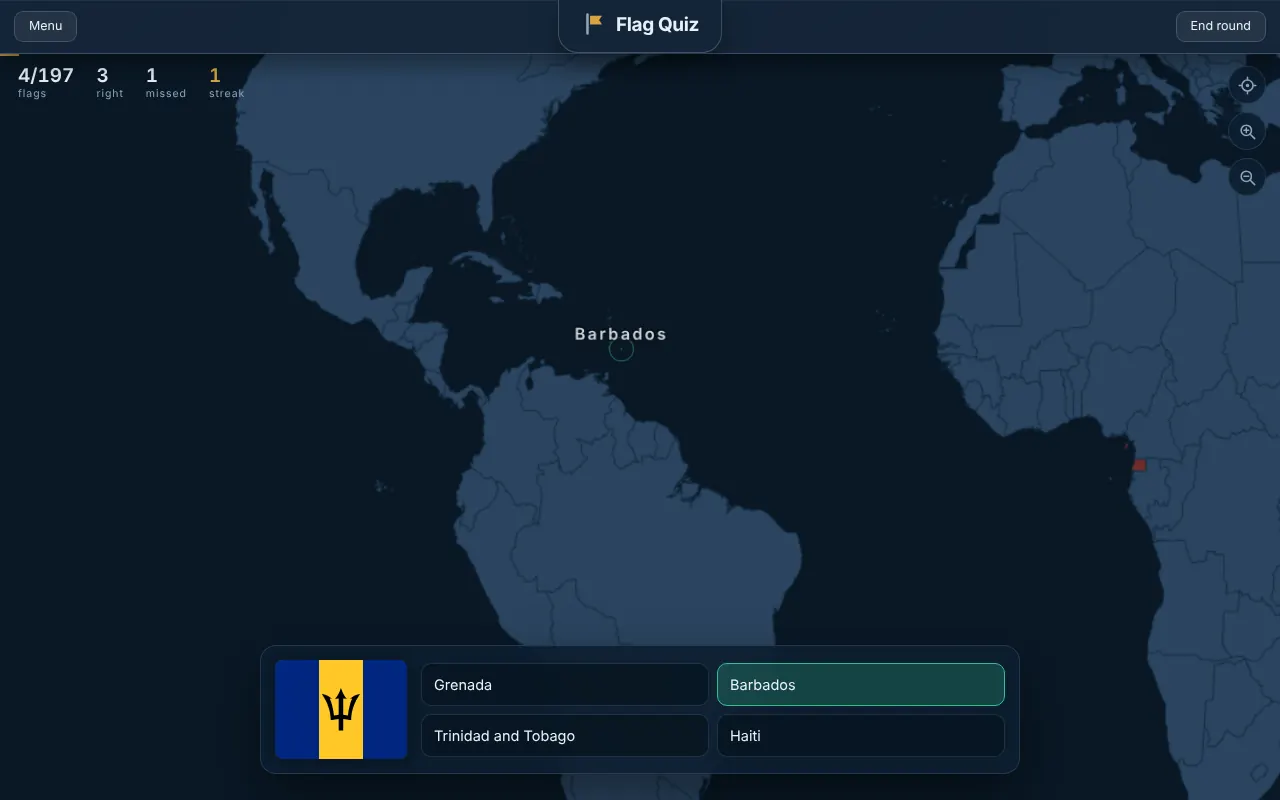
If you want to test yourself, Flag Quiz is the quickest way. Try to say what the stars mean on each one you get, it's a surprisingly good way to remember the flag itself.
Sources
- Globely's game data (the flag artwork used in Flag Quiz and Flag Peek)
- Britannica: Flag of the United States
- Britannica: Flag of Micronesia
- Britannica: Flag of Cabo Verde
- Britannica: Flag of Tuvalu
- Britannica: Flag of Venezuela
- Britannica: Flag of the Philippines
- Britannica: Flag of Uzbekistan
- Britannica: Flag of Dominica
- Federal Senate of Brazil: Law No. 5,700 of 1971 on the national symbols
- Britannica: Flag of Brazil
- Australian Government, Department of the Prime Minister and Cabinet: The Australian National Flag
- Britannica: Flag of China
- Britannica: Flag of Panama
- Britannica: Flag of Honduras
- Britannica: Flag of Ghana
- Britannica: Flag of Somalia
- Britannica: Flag of Bosnia and Herzegovina
- Office of the High Representative: Decision imposing the Law on the Flag of Bosnia and Herzegovina
The games in this guide
 GameFlag Quiz: how to playRules, scoring and tips.
 GameFlag Peek: how to playRules, scoring and tips.