How Globely's daily puzzles work
Everyone gets the same puzzles on the same day. But a friend in Tokyo probably gets tomorrow's before you do, and it's all down to one number.
It all starts with the date
Every day's puzzles come from a single number: the date. When you open Globely, your browser takes today's date in your own time zone and turns it into a day number. (It counts the days since 1 January 1970, so 25 October 2026, the date on this guide, is day 20,751.) Each game then uses that number to pick its puzzle in a fixed way, and the same day number always picks the same puzzle. So everyone playing on the same date gets the same flag, the same hidden country and the same trip, without anything being stored or sent anywhere.
It's also why nothing gets downloaded each morning. The games and their data are already on the page, and your own device works out the day's puzzle in a fraction of a second. I really like this setup, honestly. There's no server deciding anything, just a bit of maths that comes out the same for everybody.
Midnight is your midnight
Because the date comes from your own clock, the puzzles change at midnight wherever you are. A friend in Tokyo moves on to the next day's puzzles many hours before a friend in Mexico City does. So if you want to compare results with someone, compare on the same date, not at the same moment, or you might end up comparing two different puzzles.
How many hours? Time zones are set as offsets from Coordinated Universal Time (UTC), the time at the prime meridian near Greenwich. Tokyo is UTC+9 all year. Mexico City is in Mexico's central zone, and since a 2022 law only the northern border changes its clocks, it stays at UTC−6 all year. That's a 15-hour gap: when Tokyo gets new puzzles at midnight, it's 9 in the morning of the day before in Mexico City.
And it gets stranger. Some islands in Kiribati run at UTC+14, so they start each date first, and according to timeanddate.com, every day between 10:00 and 10:59 UTC three different calendar dates are in use on Earth at once. So for that hour, three different days of Globely puzzles are live. Nepal is my favourite oddity: it's UTC+5:45, so its new puzzles arrive at a quarter past the hour, UTC time.
On the hub, a line saying "New puzzles in…" counts down to your next midnight. If you leave Globely open across midnight, the hub notices within about 20 seconds and switches to the new day by itself. Clock changes for summer time don't matter either: the switch still happens at your midnight.
How each game picks its puzzle
The date is the same for every game, but each one uses it a bit differently:
- Word Grid works through all 156 possible answers in a fixed shuffled order, one a day, so no word comes back until every single one has been used. That's a cycle of about five months, which is long enough that you won't remember last time's answer (I don't, anyway). My take on the opening guess is in the first-guess guide.
- Hot and Cold and Flag Peek each pick from every country, all 197 in the game. The same country can come up again, but not on any schedule you could predict. In Flag Peek even the order the tiles lift is shared: the plainest parts of the flag (fewest colours and edges) go first, the most telling last.
- Flag Quiz shuffles all 197 flags into the day's deck, so tiny island states turn up as often as France, then sets the clock from how difficult that deck turned out to be (smaller countries count as harder). I think that's a nice touch, since the timer actually depends on what you were dealt. Most days you pick from four options and need 20 to 28 right; about one day in four you type instead, and need 12 to 17. The clock never drops below 45 seconds. On 25 October 2026 it was 16 typed answers in 90 seconds.
- Capitals works the same way with its own deck of all 197 countries, so it never matches Flag Quiz's order. Capitals are harder than flags, so the goal is lower: most days you pick from four options and need 15 to 20 right, and about one day in four you type and need 9 to 13.
- Map Quiz has two versions, Find it and Name it, and the date picks one each day, like a coin toss, so the same one can come up a few days running. The hub card tells you which one today is.
- Border Walk picks a trip with three to five countries in between on the shortest route, always starting from a country with at least two neighbours.
- Scale It picks three pairs of countries, with no country twice, the bigger one between 1.5 and 25 times the size of the smaller, and nothing under 5,000 km².
- Rank It picks ten countries and ten categories, never two opposite categories together, and only countries with a figure in all ten (more in the Rank It categories guide).
- Split It picks three countries from its list of 111.
Your streak lives in your browser
Which days you played and how you did are saved in your own browser, not on a server. There's no account to create and nothing to log in to, which is how I'd want it as a player too. The flip side is that if you clear your browser's data, or switch to another device, your streak starts over. That's the trade.
What's kept is pretty small: for each day, which daily puzzles you finished and whether you solved them, plus which "how to play" cards you've already seen and, if you've played Multiplayer, the name you used. That's what the stats panel uses for your win rate, solved count, current and longest streak, and the last seven days. The ticks on today's cards are only for the current visit, so after a reload the cards look fresh, but your stats still have the day.
A day counts towards the streak if you finished at least one daily puzzle, solved or not, and the streak stays alive until the end of the next day. In a private or incognito window, browsers throw this data away when the last private tab closes, so a streak there won't survive.
Only your first attempt at a daily puzzle counts. Some games offer a retry afterwards, which is good practice, but the result on the hub stays as it was. I think that's the right call, otherwise a streak wouldn't really mean much.
Multiplayer plays by different rules
In a Multiplayer room the puzzles aren't the daily ones. Each game in a match gets its own random puzzle, chosen when the match starts and shared with everyone in the room. So you can play as many matches in a day as you like without seeing the day's answers, which makes it a pretty good place to practise once your daily puzzles are done. Multiplayer results never touch your streak or the hub either.
A few habits that help
- Play at roughly the same time each day. Streaks die from forgetting, not from losing.
- Travelling? The puzzle follows your device's date. Fly from the Americas to Asia across the Pacific and you can skip most of a calendar date in the air, which is the one way I know to lose a streak by sitting still.
- Use the share button on the hub to send your day as a row of ticks and crosses, no answers included, so nobody gets spoiled.
- Do the daily first, then switch to practice. It deals random puzzles and never changes your results.
Sources
- Globely's game data
- NIST: How UTC(NIST) is related to Coordinated Universal Time
- timeanddate.com: Japan Standard Time, Nepal Time, The International Date Line
- Cámara de Diputados (Mexico): Ley de los Husos Horarios en los Estados Unidos Mexicanos
- MDN Web Docs (Mozilla): Window: localStorage
The games in this guide
 GameWord Grid: how to playRules, scoring and tips.
 GameFlag Quiz: how to playRules, scoring and tips.
More guides
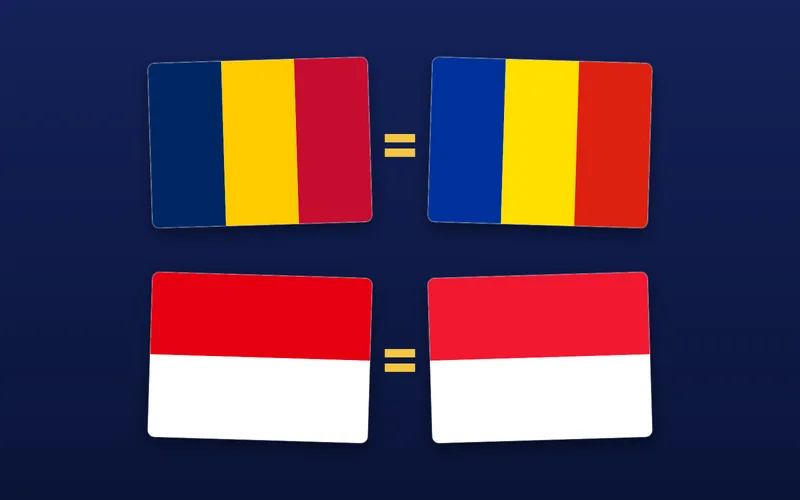 Flags · 6 min readFlags that look almost the same, and how to tell them apartEight pairs that are easy to mix up, and the one detail that separates each.
 Flags · 5 min readThe colours of the world's flags, measuredI measured every flag in Globely. Red is on three in four.
 Maps · 6 min readWhy some countries look too big on most mapsGreenland looks as big as Africa on a classroom map. Africa is fourteen times bigger.