The highest and lowest capitals in the world
La Paz sits more than 3,600 metres up the Andes. Baku sits below sea level on the Caspian. And Mexico City, where I live, is closer to the top of this list than most people would guess.
Why this one is personal
I live in Mexico City, which is about 2,240 metres above sea level. I never really think about it, it's just where home is. But when I was putting together the Capitals game for Globely, I got curious about where my city actually ranks, and the answer surprised me: it's ninth highest of all the world's capitals. Higher than any capital in Europe, by a lot.
So I made a list. A quick warning first: different sources give slightly different heights, because cities aren't flat. La Paz, for example, runs from about 3,250 to 4,100 metres depending on the neighbourhood, according to Britannica. The numbers below are the usual reference figures from the standard list of capitals by elevation, rounded the same way.
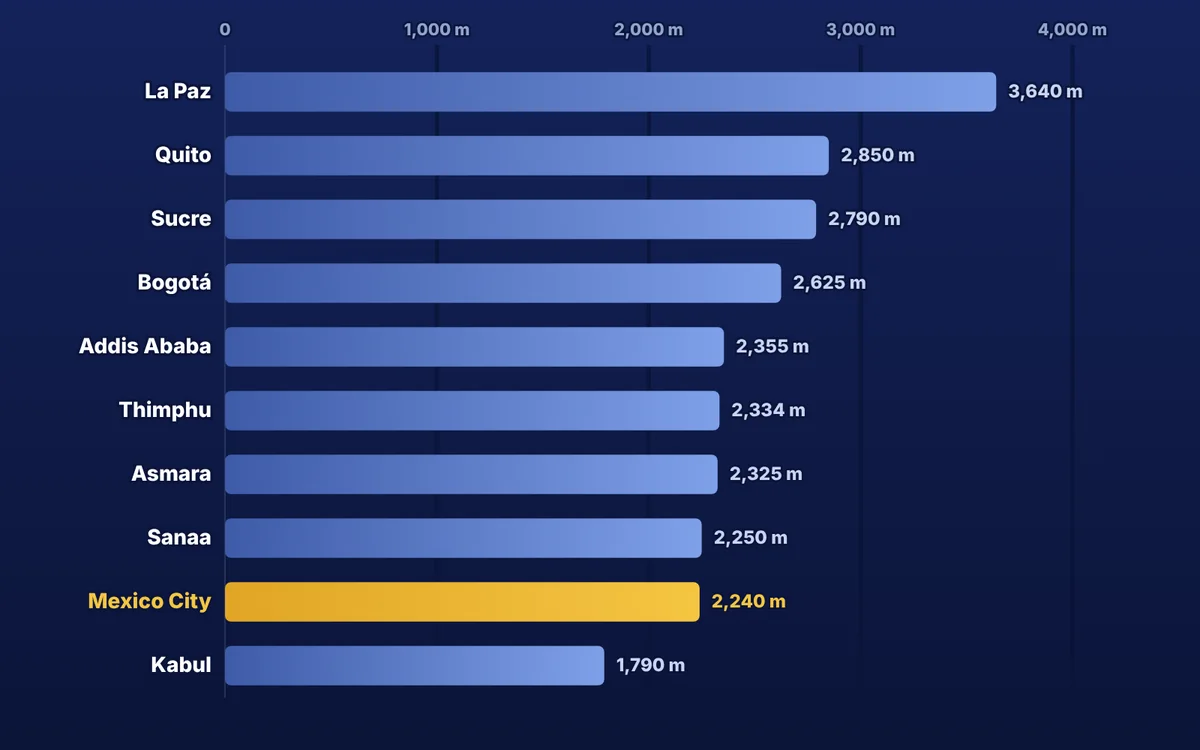
The top ten
| Capital | Country | Height (m) |
|---|---|---|
| La Paz (seat of government) | Bolivia | 3,640 |
| Quito | Ecuador | 2,850 |
| Sucre (constitutional capital) | Bolivia | 2,790 |
| Bogotá | Colombia | 2,625 |
| Addis Ababa | Ethiopia | 2,355 |
| Thimphu | Bhutan | 2,334 |
| Asmara | Eritrea | 2,325 |
| Sanaa | Yemen | 2,250 |
| Mexico City | Mexico | 2,240 |
| Kabul | Afghanistan | 1,790 |
Bolivia shows up twice, which feels a bit like cheating. Sucre is the capital in the constitution and La Paz is where the government works, which I explain in the guide to capitals that aren't the biggest city. Guinness counts La Paz as the highest capital in the world, at 3,631 metres, and calls Sucre the legal capital.
If you only count capitals with no asterisk, the winner is Quito, at about 2,850 metres and just south of the Equator. Being that high is a big part of why Quito doesn't feel like a tropical city at all, even though it's practically on the Equator. Honestly, it's one of the places on this list I'd most like to visit.
Three mountain clusters
Looking at the list on a map, the high capitals aren't random. They come from three places:
- The Andes: La Paz, Quito, Sucre and Bogotá (which Britannica puts at 2,640 metres, a little higher than the list).
- The Ethiopian Highlands and the Horn of Africa: Addis Ababa and Asmara, plus Sanaa just across the Red Sea in Yemen, which Britannica describes as more than 2,200 metres up.
- The Himalayas and around: Thimphu in Bhutan, which Britannica puts at about 2,000 metres, and Kabul further west.
Mexico City is kind of on its own here. It sits in the Valley of Mexico, which Britannica describes as a formerly lacustrine basin, a fancy way of saying it used to be full of lakes. Today only a few are left, and the city has spread over where the rest used to be.
What altitude actually changes
The air is thinner up there, and that matters more than you'd think. The most famous example happened in my city. At the 1968 Olympics in Mexico City, Bob Beamon jumped 8.90 metres in the long jump, beating the world record by 55 centimetres. Britannica says the jump was helped by the high altitude and a strong tailwind, and the record lasted 23 years. The thinner air means less resistance, which helps sprinters and jumpers. It's the opposite for anyone running long distances, because there's less oxygen in every breath.
Football is where it gets political. In May 2007 FIFA announced that international matches would no longer be allowed in stadiums above 2,500 metres. That would have kept Bolivia's national team out of its own stadium in La Paz. Bolivia's government sent a delegation to Zurich and people marched in the streets. FIFA first raised the limit to 3,000 metres, which still left out La Paz, and in May 2008 it suspended the ban after South American federations protested. It was never brought back. I think Bolivia had a point: if everyone else gets to play at home, so should they. And as someone who grew up hearing that Mexico's national team has an advantage playing at the Azteca, I'm not exactly neutral.
A few more that surprised me
A couple of capitals just outside the top ten are worth knowing too, because they explain why so much of eastern and southern Africa is cooler than people expect. Nairobi is about 1,795 metres up, Windhoek in Namibia about 1,720, Maseru in Lesotho about 1,670 and Kigali in Rwanda about 1,570. Lesotho is a fun case in general: the whole country is high, and it's completely surrounded by South Africa, which makes it look on the map like a mountain island in the middle of another country.
And Europe is nowhere. The highest capitals in Europe are small mountain ones like Andorra la Vella, and they're still far below the list above. I think that's part of why most of us never think about altitude as a thing capitals can have. Growing up in Mexico City, I had it the other way round: I assumed lots of capitals were up in the mountains, until I actually checked.
And the lowest
At the other end, lots of capitals are on the coast, so they sit at roughly sea level. But two go below it:
| Capital | Country | Height (m) |
|---|---|---|
| Baku | Azerbaijan | −28 |
| Amsterdam | Netherlands | −2 |
Baku is the lowest capital in the world, and the reason is the Caspian Sea. The Caspian isn't connected to the ocean, and its surface sits about 27 metres below sea level, according to Britannica. Baku is right on its shore, so the whole city starts below zero. (The Caspian is also the reason Azerbaijan counts as landlocked, which I go into in the guide to countries with no coastline.)
Amsterdam is a different story. The Netherlands is famous for land that was taken from the water and kept dry with dykes and pumps, and Amsterdam sits a couple of metres below the sea it's next to. So Baku is low because of its sea, and Amsterdam is low in spite of it.
The gap between the two ends of the list is huge. From Baku up to La Paz is more than 3,650 metres, about the height of a big mountain, between two capital cities.
Tip for the games: height is a surprisingly good memory hook for capitals. If you're stuck on the Andean ones in Capitals, remember they're the high ones: La Paz and Sucre for Bolivia, Quito for Ecuador, Bogotá for Colombia. And on the map in Map Quiz, the three mountain clusters from this guide (the Andes, the Horn of Africa and the Himalayas) are good anchors for placing the countries around them.
Sources
- Wikipedia: List of capital cities by elevation (heights in the tables)
- Guinness World Records: Highest capital
- Britannica: La Paz
- Britannica: Quito
- Britannica: Bogotá
- Britannica: Sanaa
- Britannica: Thimphu
- Britannica: Valley of Mexico
- Britannica: Caspian Sea
- Britannica: Bob Beamon
- Global Voices: Bolivia, a country unites behind FIFA ban on stadiums at high altitudes
- Wikipedia: High-altitude football controversy
The games in this guide
More guides
 Capitals · 5 min readHow I'd learn all 197 capitals (without losing my mind)Some capitals are free, the hard ones are hard in the same few ways, and this is the order I'd learn them in.
 Countries · 5 min readThe countries with no coastline, and why it matters so muchForty-five countries have no coast. Some lost it in a war, and one still keeps a navy anyway.