Capitals that aren't the biggest city, and why
Sydney isn't the capital of Australia, Istanbul isn't the capital of Turkey, and there's usually a slightly petty reason behind it.
Wait, Sydney isn't the capital?
Nope. It's Canberra, and if you didn't know that, you're in very good company. Sydney is huge, it has the Opera House, it's the city everyone pictures when they think of Australia. Canberra is a planned city of under half a million people that most tourists never go to. The whole capital territory had about 489,700 people in March 2026 (official figures), under 2% of the country.
The reason is pretty petty, honestly. When Australia became one country in 1901, Sydney and Melbourne both wanted to be the capital and neither would let the other win. The compromise went straight into the constitution: section 125 says the capital has to be in New South Wales (Sydney's state) but at least 100 miles from Sydney. So they agreed to build a brand new city somewhere in between. The site was picked in 1908 and Parliament only moved there in 1927. Melbourne was the stand-in capital until then.
I'll say it: Canberra exists because two cities couldn't share. And that turns out to be the story behind a lot of capitals on this list.
The "nobody could agree" capitals
Canada: Ottawa, not Toronto. In 1857 Queen Victoria picked Ottawa, a smallish town sitting right on the line between English-speaking and French-speaking Canada. Toronto and Montreal had both been capitals before and both wanted it (so did Kingston and Quebec City, which had also had a turn, as Parks Canada explains). Picking none of them was the safe move.
United States: Washington, not New York. New York actually was the first capital under the Constitution. Then in 1790 the North and South made a deal and the capital went to a new federal district on the Potomac river, roughly in the middle. The South got the capital, and in return the federal government took over the states' war debts, which the North wanted. The famous version says it was settled over dinner at Thomas Jefferson's, though the National Archives notes historians doubt that. New York is still more than ten times bigger than DC proper: about 8.58 million people against about 694,000 in the Census Bureau's 2025 estimates (New York, DC).
Switzerland: Bern, not Zurich. This one's my favourite technicality. Switzerland's constitution doesn't name a capital at all. Bern is officially the "federal city", where the government sits, and even that title only comes from ordinary law. Before 1848 the job rotated every two years between Zurich, Bern and Lucerne. Zurich is the biggest city and the money capital, but not the political one.
The "let's build one from scratch" capitals
Some countries didn't just pick a smaller city. They made a new one.
- Brazil: Brasília (biggest city: São Paulo). Opened in 1960 to pull people and money into the middle of the country, away from the coast. Seen from above, the city plan looks like an airplane or a bird, and the buildings by Oscar Niemeyer are wild. It's a UNESCO World Heritage Site now. Out of all the built-from-nothing capitals, this is the one I'd actually want to visit.
- Pakistan: Islamabad (biggest: Karachi). Karachi was the first capital. Islamabad was built in the 1960s, further north and away from the busy port. The site was picked in 1959 after Karachi was judged unsuitable, and the name means "City of Islam" (Britannica).
- Nigeria: Abuja (biggest: Lagos). It became the capital in 1991, after a 1976 decree. Abuja sits closer to the middle of the country and wasn't strongly tied to one of Nigeria's big ethnic groups, which was kind of the point. It's also on neutral ground between the mostly Muslim north and mostly Christian south.
- Myanmar: Naypyidaw (biggest: Yangon). The government moved there in 2005 and 2006, pretty suddenly. A National University of Singapore paper says ministries got the order a day before it was announced, and most people were caught by surprise. The name means "Abode of Kings". Photos of its 20-lane highway with almost no cars on it are famous on the internet.
- Kazakhstan: Astana (biggest: Almaty). Capital since 1997. It was renamed Nur-Sultan in 2019, after the president who had just stepped down, and then back to Astana in 2022, which is a nightmare for anyone making a geography game.
The ones that just stayed small
Not everything is a big political story. Sometimes the capital was chosen a long time ago and another city simply grew faster.
| Country | Capital | Biggest city |
|---|---|---|
| Turkey | Ankara | Istanbul |
| New Zealand | Wellington | Auckland |
| Morocco | Rabat | Casablanca |
| Vietnam | Hanoi | Ho Chi Minh City |
| China | Beijing | Shanghai |
| Tanzania | Dodoma | Dar es Salaam |
| Ivory Coast | Yamoussoukro | Abidjan |
Turkey is the one I see people get wrong the most. Istanbul feels like it should be the capital (it was, for the Ottoman Empire), but Atatürk moved it to Ankara in 1923 when the republic started. Ankara had been his base since 1919, so it wasn't a random pick. New Zealand moved its capital from Auckland to Wellington back in 1865, partly because Wellington is more in the middle of the two islands. And the choice was made by three commissioners from Australia.
Two rows in that table are cheating a little, though. Dodoma and Yamoussoukro were picked on purpose, and fairly recently. Tanzania named Dodoma, about 480 km inland, as its capital in 1974, and moving the government there has taken decades. Yamoussoukro became the capital of Ivory Coast in 1983, and it was the home town of the president, Félix Houphouët-Boigny, which tells you most of the story. Abidjan carried on as the real working capital anyway.
And then there are the weird ones
South Africa has three capitals. Pretoria for the government, Cape Town for Parliament and Bloemfontein for the courts, according to the South African government (though the Constitutional Court sits in Johannesburg). And the biggest city is none of them, it's Johannesburg.
Bolivia has two. Sucre is the capital in the constitution, La Paz is where the government actually works. That split goes back to an 1898 compromise. The biggest city? Santa Cruz.
The Netherlands is the opposite case. Amsterdam is the capital and the biggest city, but the government, parliament and a royal palace are all in The Hague. So it's a capital that doesn't really do capital stuff.
Quick way to remember them: if a country is big, federal, or was formed by joining regions that didn't trust each other, there's a good chance the capital isn't the biggest city. Australia, Canada, the US, Brazil, Nigeria, Switzerland all fit that pattern. Centralised countries (France, the UK, Japan, Egypt) almost always have one giant city that is also the capital. Mexico breaks the rule a bit: it's federal, and Mexico City is still the biggest by miles.
Three tells that help in a quiz
- The name sounds new. Brasília is the country's name turned into a city, Islamabad means "City of Islam" and Naypyidaw "Abode of Kings". Names like that usually belong to purpose-built capitals.
- The big city is a port. Karachi, Lagos, Dar es Salaam, Abidjan and Yangon are all on the coast, and in each case the capital ended up inland.
- Two big cities are rivals. Sydney and Melbourne, Toronto and Montreal. When two cities are about equally important, the capital is often a third place neither of them wanted.
Where this shows up in Globely
Knowing where countries actually sit helps a lot in Hot and Cold and Map Quiz, and the "build a capital in the middle" idea is a nice clue for remembering where a capital is on the map. Brasília, Abuja and Canberra are all inland on purpose.
Sources
- Australian Bureau of Statistics: population
- Parliamentary Education Office: Seat of Government Act 1908
- City of Ottawa: Ottawa Becomes the Capital
- Parks Canada: Canada's Capital
- US National Archives: The Compromise of 1790
- US Census Bureau: New York City
- US Census Bureau: District of Columbia
- swissinfo.ch: Why Switzerland hasn't got a capital
- UNESCO: Brasilia
- Federal Capital Development Authority, Nigeria
- BlackPast: Abuja
- National University of Singapore: The Road to Naypyitaw
- Te Ara (New Zealand): Capital city
- South African Government: South Africa at a glance
- Encyclopaedia Britannica: Brasília, Islamabad, Nay Pyi Taw, Astana, Ankara, Dodoma, Yamoussoukro, Sucre, The Hague
The games in this guide
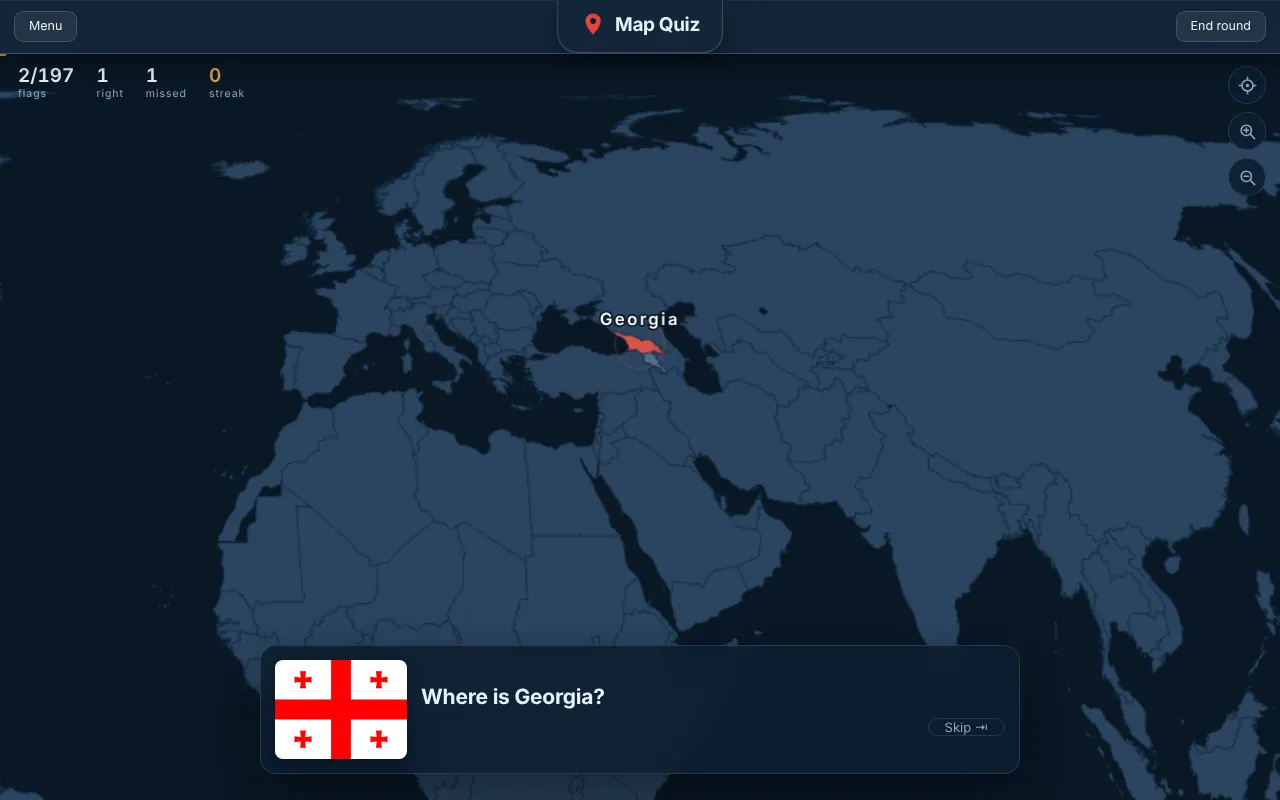 GameMap Quiz: how to playRules, scoring and tips.
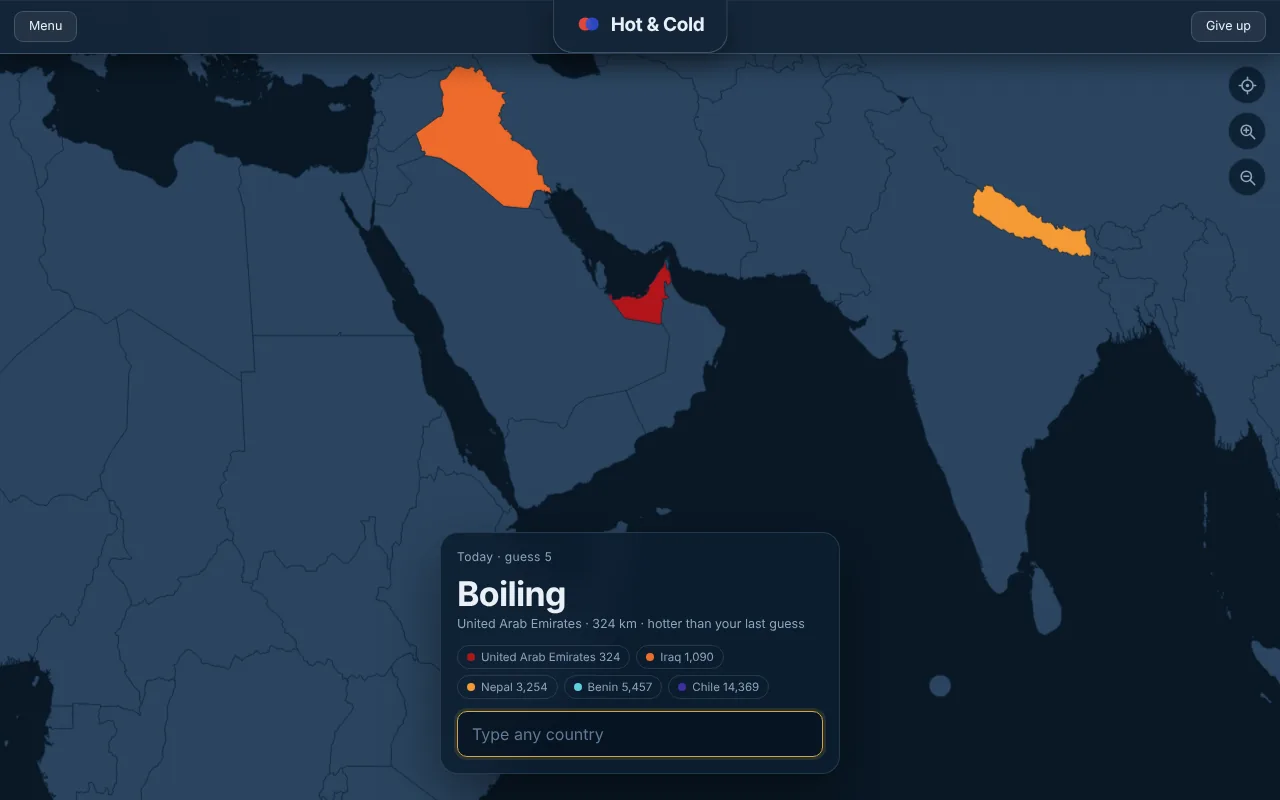 GameHot and Cold: how to playRules, scoring and tips.