Countries that changed their names, and what Globely accepts
Swaziland is Eswatini now, Turkey is Türkiye, and the Czech Republic is (sort of) Czechia. Here's what changed, and which old names you can still type into Globely.
Country names change more often than you'd think. Sometimes it's after a revolution, sometimes it's just a quiet request to the United Nations. Here are the changes you're most likely to run into, and how Globely deals with them. The short version: the game shows each country under one name, usually the current one, but its answer box accepts lots of older or alternative names too. I'd much rather let you through with Swaziland than mark you wrong for knowing an older name.
The recent ones
| Now | Before | Changed | Globely accepts the old name? |
|---|---|---|---|
| Türkiye | Turkey | 2022 | Yes |
| North Macedonia | Macedonia | 2019 | Yes |
| Eswatini | Swaziland | 2018 | Yes |
| Czechia | Czech Republic (still the full name) | 2016 | Yes |
| Cabo Verde | Cape Verde | 2013 | Yes, both |
| Timor-Leste | East Timor | 2002 | Yes |
| Myanmar | Burma | 1989 | Yes |
| Côte d'Ivoire | Ivory Coast | 1985 | Yes, both |
What actually happened in each case
Türkiye. In 2022 the United Nations agreed to use Türkiye, the country's own spelling, instead of Turkey. The UN's member page dates it to 26 May 2022, after the foreign minister wrote to the Secretary-General asking for it. Globely shows Türkiye, and in Word Grid it's spelt TURKIYE, since the grid doesn't do accents. In the answer box, Turkey, Turkiye and Türkiye all land on the same country.
North Macedonia. This name came out of the 2018 Prespa Agreement with Greece, which ended a long dispute over the name Macedonia (it's also the name of a Greek region). It took effect in February 2019, on the 12th, after both parliaments had voted it through. The long name people used in the meantime, "the former Yugoslav Republic of Macedonia", is in the answer box too, if you really want to type all that.
Eswatini. In April 2018 the king announced that Swaziland would use its name in the siSwati language, Eswatini. The UN records the change as taking effect on 19 April 2018. Pretty simple, as name changes go.
Czechia. In 2016 the Czech Republic registered Czechia with the UN as its official short name. The full name didn't change, so both are right, Czechia is just the one-word form. The Czech foreign ministry explains that the short form Česko had existed since 1993, and a government resolution on 2 May 2016 got its translations, Czechia included, into the UN's databases. Honestly I think this is the most sensible one on the list. Lots of countries have a long name and a short one (France is officially the French Republic, and nobody calls it that in a quiz).
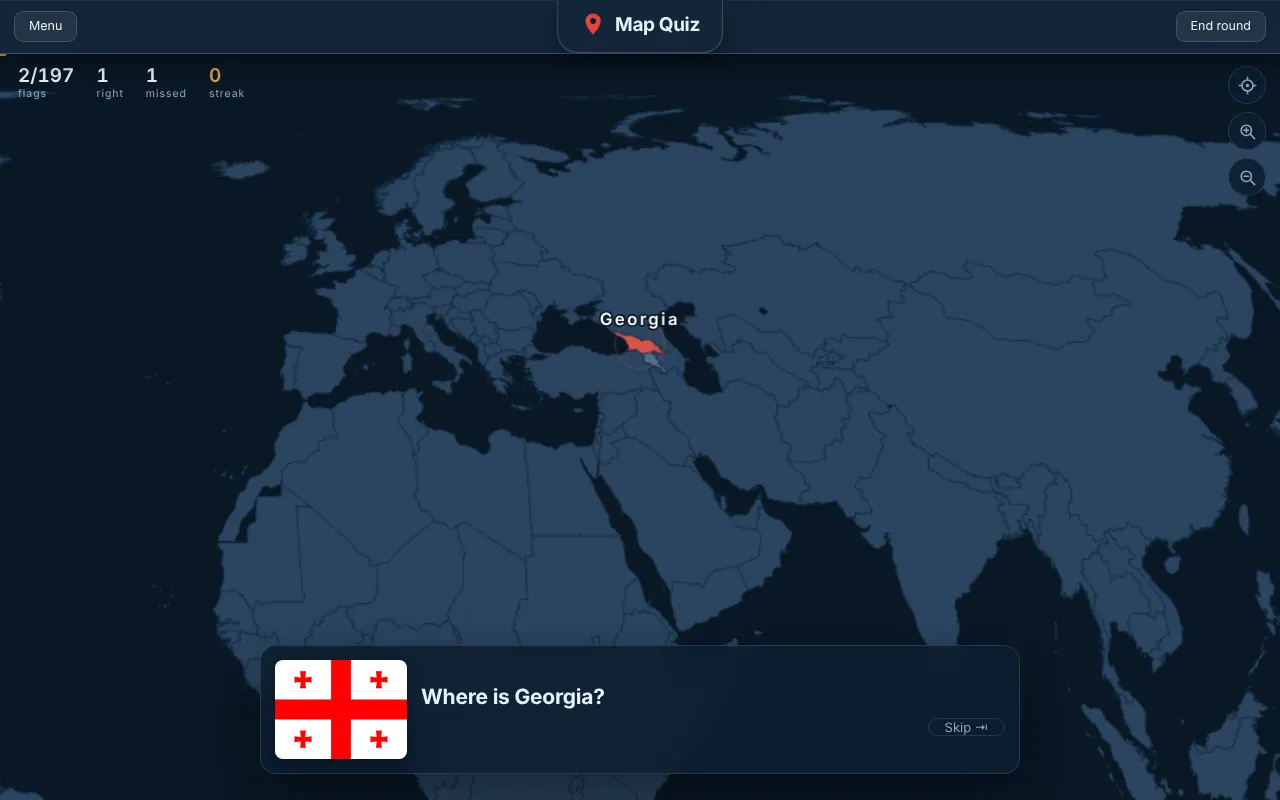
Cabo Verde and Côte d'Ivoire. Neither of these really changed its name. They asked the world to stop translating it. Côte d'Ivoire made that request in 1985, and Cabo Verde in 2013 (the UN dates it to 24 October). In English, Ivory Coast and Cape Verde are still really common, so Globely shows those familiar forms and accepts both. Some people will disagree with that call, I know, but I'd rather show the name most players will recognise.
Timor-Leste. The official name since independence in 2002. East Timor is the older English form, and it still works.
Myanmar. The military government changed the English name from Burma in 1989, and the UN was told on 18 June that year. Both are still in use, and some governments and newspapers kept saying Burma for years. The full name changed again in 2011, to the Republic of the Union of Myanmar.
Read the UN's own notes on these and the same pattern shows up every time: the UN doesn't pick the name. The country writes in, and the UN updates its records. For Türkiye it was the foreign minister, for Cabo Verde the country's ambassador to the UN. Which is why I find "the UN renamed Turkey" a slightly funny way to put it.
Old names that won't work
The answer box is meant for the names people actually type today, so names that went out of use generations ago aren't accepted. Zaire (DR Congo from 1997), Ceylon (Sri Lanka from 1972), Siam (Thailand from 1939, and for good from 1949) and Persia (Iran, which asked other countries to use its own name in 1935) all need the current name. The line has to go somewhere, and I think "do people still actually say it?" is a fair test. Plenty of people still say Burma. Not many say Siam.
Zaire, for the record, was Mobutu Sese Seko's choice in 1971, from a local word for "great river", meaning the Congo, and Ceylon, which officially became Sri Lanka in 1972, still turns up in trade names (Ceylon tea being the famous one). Upper Volta doesn't work either. It became Burkina Faso in 1984, a name that means "land of incorruptible people", and Burkina Faso is one of just two countries (Tuvalu is the other) that the answer box knows by a single name.
Kampuchea is the odd exception. It does work for Cambodia, but only because Kâmpŭchéa is the country's own name in Khmer, and the game keeps a list of local names.
The answer box, by the numbers
I counted. Across the 197 countries in the game, the answer box knows 1,150 different names, so about six per country. They come from the name the game shows, a long list of official and local names in other languages, and a short hand-made list of extras (that's where UK, USA and DRC live).
South Africa has the most, 15, mostly because its name is listed in many of its official languages, from Suid-Afrika to Mzantsi Afrika. DR Congo (14) and Vatican City (13) come next.
Before comparing anything, the game strips accents and capitals from what you type and turns punctuation into spaces. So Côte d'Ivoire, Cote d Ivoire and cote d'ivoire all work. The spaces still count, though, so cotedivoire in one go doesn't.
Word Grid plays by stricter rules
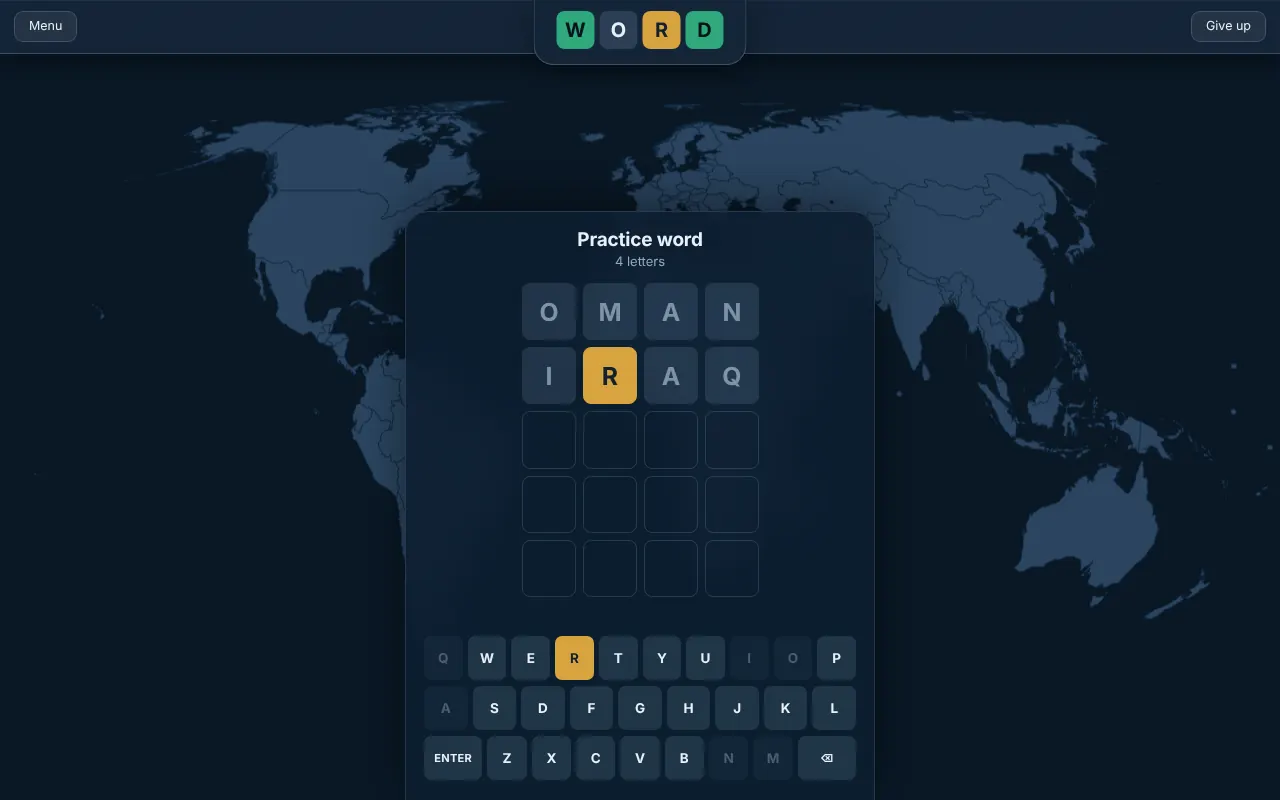
This one catches people out. Word Grid's answers, and the guesses it accepts, are only the names the game displays, and only the ones that are a single word of four to ten letters. That's 156 countries. So in Word Grid it's TURKIYE, CZECHIA, ESWATINI and MYANMAR. BURMA is five letters and a perfectly good old name, but the grid will tell you it's not a country it knows. And names with a space or a hyphen, like Ivory Coast, Cape Verde, Timor-Leste or North Macedonia, never come up as answers at all. (If you want the best opening word for each length, that's in the Word Grid first-guess guide.)
Other names that work
Besides old names, the answer box also takes common short forms and lots of names in other languages: UK and Britain for the United Kingdom, USA for the United States, Holland for the Netherlands, DRC for DR Congo, and local forms like Deutschland or España. If a name you think is right isn't accepted, the contact page explains how to send it in. I'd genuinely like to know.
Sources
- Globely's game data (the country names and alternative names the answer box accepts)
- United Nations: Member States, Türkiye
- Britannica: North Macedonia
- United Nations: Member States, Eswatini
- Ministry of Foreign Affairs of the Czech Republic: Czechia
- United Nations: Member States, Côte d'Ivoire
- United Nations: Member States, Cabo Verde
- United Nations: Member States, Myanmar
- Britannica: Democratic Republic of the Congo
- Britannica: Sri Lanka
- Britannica: Burkina Faso
The games in this guide
More guides
 Strategy · 6 min readWho comes first in each of Rank It's 36 categoriesThe country that tops every category in Rank It, from tallest men to most volcanoes.
 How it works · 6 min readHow Globely's daily puzzles workWhy everyone gets the same puzzle on the same day, and why your friend in Tokyo gets it first.
 Flags · 6 min readFlags that look almost the same, and how to tell them apartEight pairs that are easy to mix up, and the one detail that separates each.