Who comes first in each of Rank It's 36 categories
Canada's coastline is kind of absurd, and somehow Iceland comes first three times. Here's who tops every one of Rank It's 36 categories.
First among 130, not the whole world
Quick thing before the list. Rank It doesn't use every country, it uses 130 of them: most of the world's larger countries, plus well-known smaller ones like Iceland, Luxembourg, Malta and Qatar. So when I say a country comes "first" below, I mean first among those 130, not first on the whole planet.
Some countries just aren't in the game. That goes for very small states like Monaco, and also for bigger ones like Burundi and South Sudan. And it does change a few answers. Burundi, for instance, has a lower GDP per person than any country in the game, so it would take that category if it were in. All the figures here are the ones the game actually uses, from the sources in the table.
The ones that surprise people
- Coastline: Canada's is about 202,000 km. That's more than three and a half times the next country's, which is Indonesia's. Honestly this is my favourite number in the whole game, it just looks like a typo.
- Coldest average temperature: Canada again (−4 °C over a year), only just ahead of Russia. I'd have guessed Russia too, so don't feel bad.
- Hottest average temperature: Mali, at 29.2 °C, ahead of Senegal.
- Tallest men: the Netherlands, with an average of 182.5 cm. This is probably the one most people get right.
- Most meat eaten per person: Mongolia, ahead of the United States and Australia.
- Iceland comes first three times: fish eaten, fresh water per person and electricity used per person. Pretty impressive for a country with so few people.
- Highest peak: it's a tie. China and Nepal share Mount Everest, at 8,849 m, so they both get it.
- Renewable electricity: seven countries make essentially all of their electricity from renewables, among them Albania, Costa Rica, Iceland, Nepal and Paraguay.
All 36 categories
| Category | First | Figure | Source |
|---|---|---|---|
| 👥 Largest population | India | 1.45 billion people | UN World Population Prospects, 2024 |
| 🗺️ Largest total area | Russia | 17.1 million km² | UN Statistics Division, total area |
| 🏙️ Highest population density | Singapore | 7,829 people per km² | Population divided by total area |
| 🏦 Highest GDP | United States | $27.4 trillion | World Bank GDP, 2023 (US$) |
| 💰 Highest GDP per capita | Luxembourg | $128,678 per person | World Bank GDP per person, 2023 |
| 🪙 Lowest GDP per capita | Afghanistan | $357 per person | World Bank GDP per person, 2023 |
| ⚖️ Least perceived corruption | Denmark | score 89 of 100 | Corruption Perceptions Index, 2025 |
| 🕵️ Most perceived corruption | Somalia | score 9 of 100 | Corruption Perceptions Index, 2025 |
| 😊 Happiest population | Finland | 7.74 out of 10 | World Happiness Report, 2025 |
| 🏅 Most Olympic medals won | United States | 3,137 medals | All-time Olympic medal table, Summer and Winter |
| 🏔️ Highest peak elevation | China, Nepal | 8,849 m | Highest point in each country |
| ⏳ Highest life expectancy | Japan | 84.7 years | Life expectancy, UN World Population Prospects (2023) |
| 👵 Oldest population | Japan | median age 49.9 | Median age, CIA World Factbook (2024) |
| 🧒 Youngest population | Niger | median age 15.2 | Median age, CIA World Factbook (2024) |
| 👶 Highest fertility rate | Chad | 5.94 children per woman | Births per woman, UN World Population Prospects 2024 |
| 📏 Tallest population | Netherlands | 182.5 cm | Average height of men, NCD-RisC |
| 🔥 Highest average temperature | Mali | 29.2 °C | Average yearly temperature, 1991–2020 (World Bank) |
| ❄️ Lowest average temperature | Canada | −4.0 °C | Average yearly temperature, 1991–2020 (World Bank) |
| 🌧️ Highest annual rainfall | Colombia | 3,240 mm a year | Average yearly rainfall (World Bank) |
| 🌲 Highest forest cover | Papua New Guinea | 79% of land | Share of land covered by forest, FAO 2022 |
| 🌊 Longest coastline | Canada | 202,080 km | Coastline, CIA World Factbook |
| 🤝 Most bordering countries | China, Russia | 14 countries | Countries sharing a land border |
| 🚨 Highest homicide rate | Haiti | 64.3 per 100,000 | Homicides per 100,000 people, UNODC (latest year) |
| 🏭 Highest CO₂ emissions per capita | Qatar | 41.3 t per person | Global Carbon Project, 2024 |
| ♻️ Most renewable electricity | Albania, Costa Rica, DR Congo, Ethiopia, Iceland, Nepal, Paraguay | 100% | Share of electricity from renewables (Ember) |
| 🛢️ Most oil produced | United States | 18.9% of world output | Share of world oil production (Energy Institute, 2024) |
| 🍚 Most rice eaten | Myanmar | 271 kg per person | Rice supply per person, FAO food balances, 2023 |
| 🥩 Most meat eaten | Mongolia | 136 kg per person | Meat supply per person, FAO food balances, 2023 |
| 🐟 Most fish and seafood eaten | Iceland | 84 kg per person | Fish and seafood supply per person, FAO, 2023 |
| 🌍 Most residents born abroad | Qatar | 76.7% of residents | International migrant stock, UN DESA, 2024 |
| 👩💼 Most women in the workforce | Madagascar | 82.9% | Female labor force participation, ILO modelled estimates, 2025 |
| 💧 Most fresh water per person | Iceland | 445,023 m³ per person | Renewable internal freshwater, FAO AQUASTAT, 2022 |
| ⚡ Most electricity used per person | Iceland | 48,424 kWh per person | Electricity demand per person, Ember, 2025 |
| 🚬 Highest tobacco use | Lebanon | 46.9% of adults | Adults who smoke or use tobacco, WHO, 2024 |
| 🌋 Most volcanoes | United States | 165 volcanoes | Holocene volcanoes, Smithsonian Global Volcanism Program (overseas territories included) |
| 🛂 Most powerful passport | Singapore | 192 destinations | Henley Passport Index, 2026 |
When two countries have exactly the same figure, both are listed (that's how Everest ends up shared). In the game itself a tie works the same way: both countries score the same points in that category, which I think is the only fair way to do it. One quirk: tied countries share the average of their places, so each of the seven in the renewables tie counts as 4th, and Iceland's "first" there scores 99, not 100.
Why the same few countries keep winning
There's a pattern here. Totals (population, area, GDP, coastline, volcanoes) go to giants, and Russia and the United States each make the top 3 in six categories. Per-person figures go to small countries. And 71 of the 130 don't make a top 3 anywhere.
Per-person numbers get wild when the population is tiny. Iceland has 393,404 people in the game, and its power company Landsvirkjun sells about 85% of what it generates to power-intensive industry like aluminium smelters. So a big share of those 48,424 kWh goes to smelters, not kitchens. Luxembourg gets a similar boost in GDP per person: 47% of its employees commute in from abroad, adding to GDP without counting as residents.
Not everything is measured how you'd think
Coastline depends on your ruler. The game's US figure, from the CIA World Factbook, is 19,924 km, but NOAA's official US shoreline, measured on its most detailed charts and including the Great Lakes, is 153,646 km. (The CIA retired the Factbook in February 2026.)
Food is supply, not plates. The FAO counts food available to eat and notes that what's actually eaten may be lower, because of waste.
Women in the workforce looks backwards, with Madagascar on top. The World Bank explains why: rates are very high in the poorest countries, largely because subsistence farming needs everyone.
So how do you actually use this?
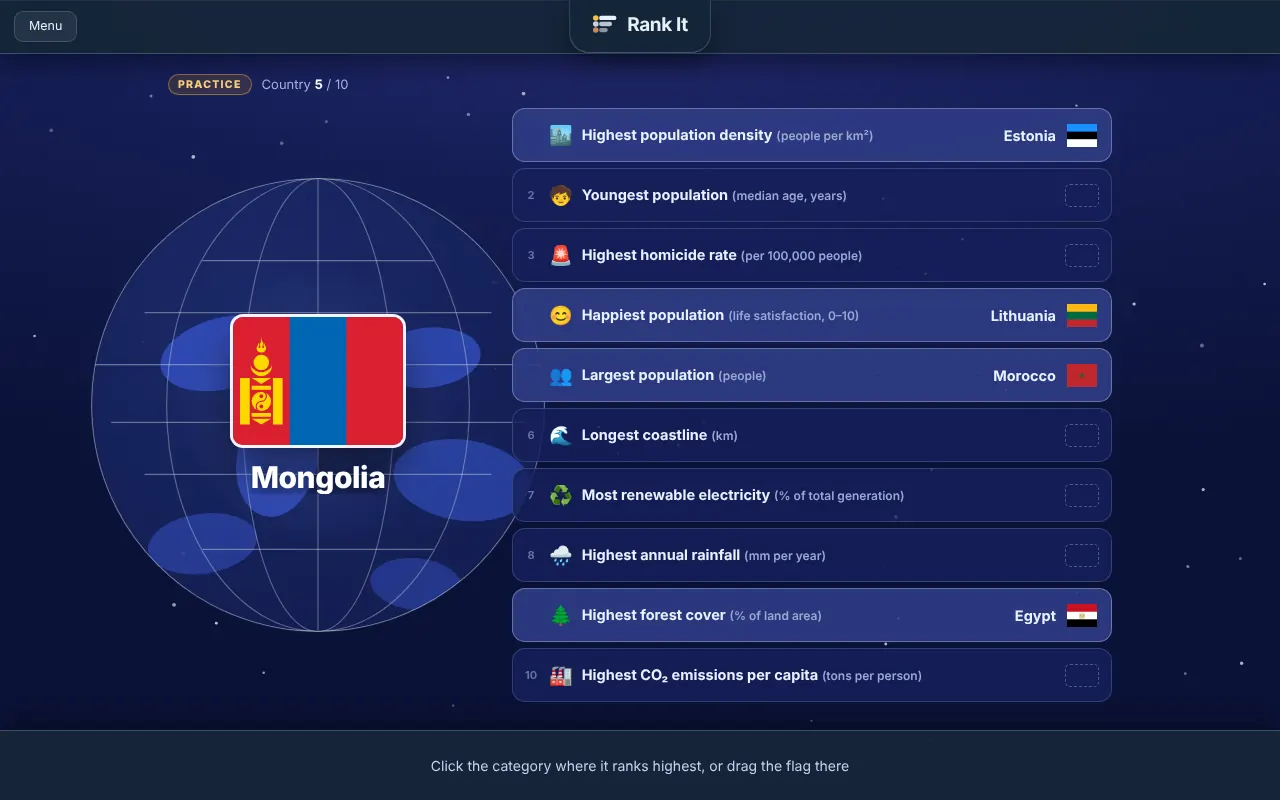
Here's the catch. Knowing who comes first isn't the same as knowing where to put a country. The real skill in Rank It is spending each country on the category where it ranks highest among its own ten, not among all 130.
Big all-rounders like the United States and China can rank well almost anywhere, so I'd hold on to them. Save them for the categories nobody else in the set can fill, and let the more specialised countries take the ones they're good at. Honestly, that one decision is where I think most of the points are won or lost.
The scoring is also gentle near the top: with all 130 countries ranked, 10th still gets 92 points, but 65th gets 37. So 10th instead of 1st barely matters, but the wrong category does. I'd avoid the disaster first.
Brazil is the dream: never top 3, but top 10 in eight categories. Armenia is the nightmare: its best category is lowest average temperature, where it's only 17th. I'd give a country like that its best spot straight away.
Sources
- Globely's game data
- UN DESA: World Population Prospects, migrant stock
- World Bank: GDP, GDP per capita, climate portal, women at work
- FAO: food balances, AQUASTAT
- Transparency International: CPI 2025
- World Happiness Report
- NCD-RisC: adult height
- CIA: The World Factbook
- NOAA: US shoreline
- UNODC: Data Portal
- Global Carbon Project: Global Carbon Budget
- Ember: electricity data
- Energy Institute: Statistical Review
- ILO: ILOSTAT
- WHO: tobacco
- Smithsonian: Global Volcanism Program
- Henley & Partners: Passport Index
- Landsvirkjun: customers
- STATEC: labour market
The games in this guide
More guides
 How it works · 6 min readHow Globely's daily puzzles workWhy everyone gets the same puzzle on the same day, and why your friend in Tokyo gets it first.
 Flags · 6 min readFlags that look almost the same, and how to tell them apartEight pairs that are easy to mix up, and the one detail that separates each.
 Flags · 5 min readThe colours of the world's flags, measuredI measured every flag in Globely. Red is on three in four.