The country with the most time zones is France (yes, France)
Not Russia, not the US. France has 12 time zones, more than any other country, and only one of them is in Europe.
The top of the list
Most people guess Russia, because it's huge and crosses most of Asia. That's a good guess (I'd have said Russia too, honestly), and it's wrong. Here's the actual ranking, counting every territory that belongs to each country, from timeanddate.com:
| Country | Time zones | Where they come from |
|---|---|---|
| France | 12 | Overseas islands in three oceans, plus French Guiana |
| Russia | 11 | One long piece of land, plus Kaliningrad |
| United States | 11 | Alaska, Hawaii and the Pacific islands |
| United Kingdom | 9 | Overseas territories |
| Australia | 9 | The mainland and its outlying islands |
| Canada | 6 | All on the mainland and islands next to it |
| Denmark | 5 | Mostly Greenland |
| New Zealand | 5 | Pacific islands |
So the trick is that this list isn't really about size. It's about who held on to islands scattered across the oceans. Russia earns its 11 the honest way, with one enormous block of land; France gets its 12 by having little pieces of itself all over the planet.
France's twelve, one by one
Mainland France is on Central European Time, UTC+1, like Germany and Italy. Every other zone belongs to an overseas region or territory. This is the full set, from timeanddate.com's list for France, shown at the moment when it's noon in Paris in winter:
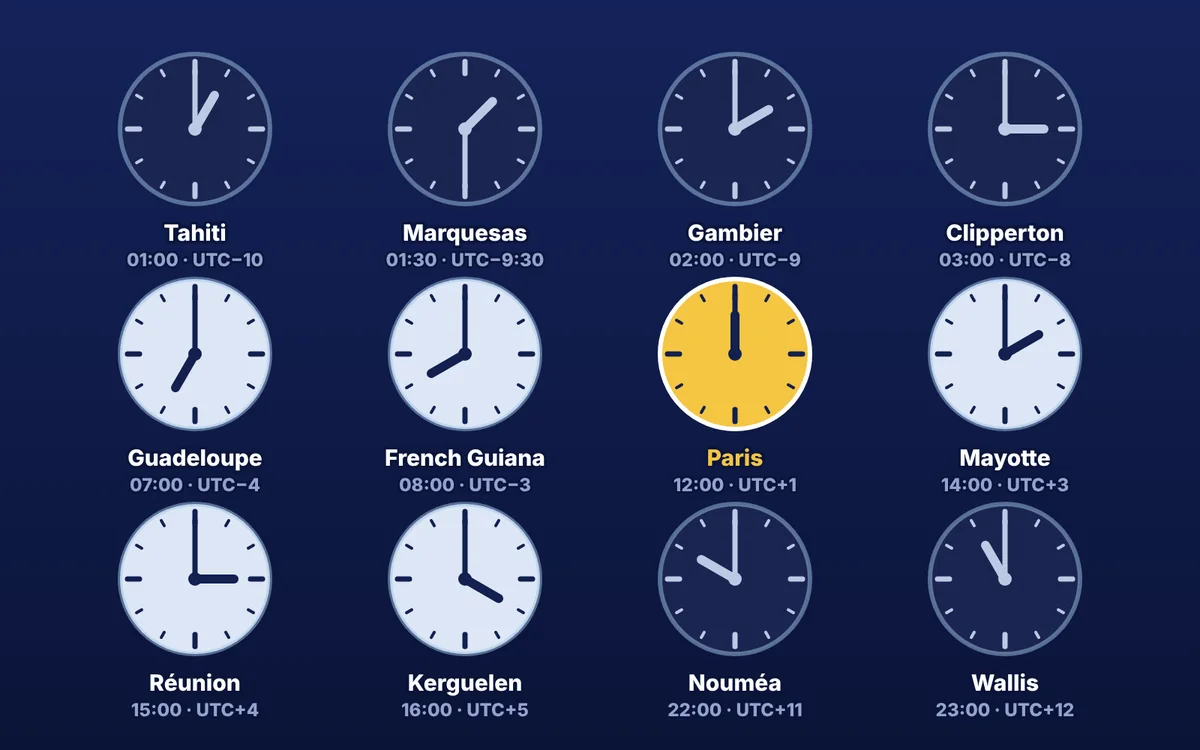
- Pacific: French Polynesia uses three on its own. Tahiti is UTC−10, the Marquesas Islands are UTC−9:30, and the Gambier Islands are UTC−9. Then there's tiny Clipperton Island at UTC−8, New Caledonia at UTC+11 and Wallis and Futuna at UTC+12.
- Atlantic and the Americas: Guadeloupe, Martinique, Saint Martin and Saint Barthélemy are UTC−4. French Guiana and Saint Pierre and Miquelon are both UTC−3, so they share one zone.
- Indian Ocean: Mayotte is UTC+3, Réunion is UTC+4, and the French Southern Territories (including the Kerguelen Islands) are UTC+5.
And Saint Pierre and Miquelon, the little islands off Canada, changes its clocks for summer, so for part of the year France technically has a 13th local time. I kind of love that a country this size is basically everywhere at once.
The wildest number here, at least to me: Wallis and Futuna (UTC+12) and Tahiti (UTC−10) are 22 hours apart. Both are France. So for most of every day, France is living two different dates at the same time.
One thing to know for the games: Globely's map draws France as the European part only. In Map Quiz you click the hexagon, not Tahiti. But your Globely puzzles still follow your own clock, so a player in Tahiti gets the day's new puzzles 11 hours after a player in Paris (in winter). There's more on that in how the daily puzzles work.
For me in Mexico City, which stays on UTC−6 all year, noon in Paris in winter is 5 in the morning. And Wallis and Futuna starts the next day at 6 in the morning my time, so by the time I've had breakfast, people there are already playing tomorrow's puzzles. I still find that a little strange every time I think about it.
Russia and the US, the runners-up
Russia's 11 zones go from UTC+2 in Kaliningrad, the piece of Russia between Poland and Lithuania, to UTC+12 on the Kamchatka Peninsula. Ten of those are on one continuous landmass, which no other country can say. In Globely, Russia is also the biggest country on the map by far, and it shares the record for most neighbours with China (14 each).
The US also gets to 11, but only because its zones run from UTC−12 on Baker Island to UTC+12 on Wake Island. Those are specks in the Pacific with almost nobody on them. The 48 states in one block only use four zones: Eastern, Central, Mountain and Pacific.
China, which goes the other way
China is about 4,800 km wide and covers more than 60 degrees of longitude. That's wide enough for four or five time zones. It used to have five, from 1912 to 1949. Then the new government put the whole country on Beijing time, UTC+8, and it's been one zone ever since.
The result is that in the far west the clock and the sun don't agree at all. In Kashgar, solar noon (when the sun is highest) can come as late as 3:10 in the afternoon. Many Uyghurs in Xinjiang use an unofficial local time instead, two hours behind Beijing. I think this is a great example of a time zone being a political decision more than a geographical one.
Clocks that disagree with the sun
The sun moves 15 degrees of longitude every hour (360 degrees in 24 hours). So you can work out a "sun time" for any place from its longitude, and compare it with the clock. I did that for the middle of each country, using the coordinates in Globely's map data and each country's winter time:
| Country | Clock time | Clock ahead of the sun by |
|---|---|---|
| Spain | UTC+1 | about 1 h 16 min |
| Argentina | UTC−3 | about 1 h 16 min |
| Iceland | UTC+0 | about 1 h 12 min |
| China | UTC+8 | about 1 h |
| France | UTC+1 | about 52 min |
| Kazakhstan | UTC+5 | about 28 min |
| India | UTC+5:30 | about 22 min |
| United Kingdom | UTC+0 | about 8 min |
Spain is the famous case. It sits in line with Britain and Portugal, which use UTC+0, but its clocks match countries as far east as Poland and Hungary. According to NPR, Franco moved Spain forward an hour in the early 1940s to line up with Nazi Germany, and it never moved back. That's part of why Spanish dinners feel so late to visitors: by the sun, they aren't quite as late as the clock says.
The others are on the list for their own reasons. Argentina is on UTC−3 even though, going by the sun, the middle of the country is closer to UTC−4. Iceland stays on UTC+0 all year, with no summer time. And Kazakhstan moved the whole country onto one zone, UTC+5, on 1 March 2024. (If you mix up Kazakhstan and its neighbours, I wrote a whole guide on the "-stan" countries.)
Half hours, quarter hours and skipped days
Most zones are whole hours from UTC, but not all. India Standard Time is UTC+5:30, used across the whole country and in Sri Lanka. New Zealand's Chatham Islands are UTC+12:45, and Nepal is UTC+5:45 (the daily puzzles guide has more on Nepal and on Kiribati, which starts every new date first).
Venezuela had its own half hour for a while. Hugo Chávez moved it to UTC−4:30 in late 2007, and in 2016 it moved back to UTC−4 to cut electricity use in the evenings during a drought.
And then there's Samoa, which on the night of 29 December 2011 went straight from Thursday to Saturday. It skipped Friday 30 December entirely, to move to the other side of the International Date Line and line up its calendar with Australia and New Zealand, its key trading partners. Back in 1892 it had done the opposite and celebrated 4 July twice. Samoa also switched to driving on the left two years before, for basically the same reason.
Tip for the games: the 15-degrees-an-hour rule works backwards too. If a country is three time zones east of another, it's roughly 45 degrees of longitude further east. At the equator that's about 5,000 km (Earth is about 40,075 km around, so each degree is about 111 km). It's a rough guide, since zones follow borders and politics, but in Hot and Cold it's a handy way to sanity-check a distance before your next guess.
Sources
- Globely's game data (country coordinates, neighbours and the map used in Map Quiz and Hot and Cold)
- timeanddate.com: Which country has the most time zones?
- timeanddate.com: Time zones in France
- timeanddate.com: China's single time zone
- NPR: Spain's been in the wrong time zone for seven decades
- timeanddate.com: Argentina Time
- timeanddate.com: Time zone in Iceland
- Government of Kazakhstan: A single time zone from 1 March 2024
- timeanddate.com: India Standard Time
- timeanddate.com: Chatham Island Standard Time
- timeanddate.com: Venezuela changes time zone
- The Christian Science Monitor: Samoa skips Friday in leap across international dateline
The games in this guide
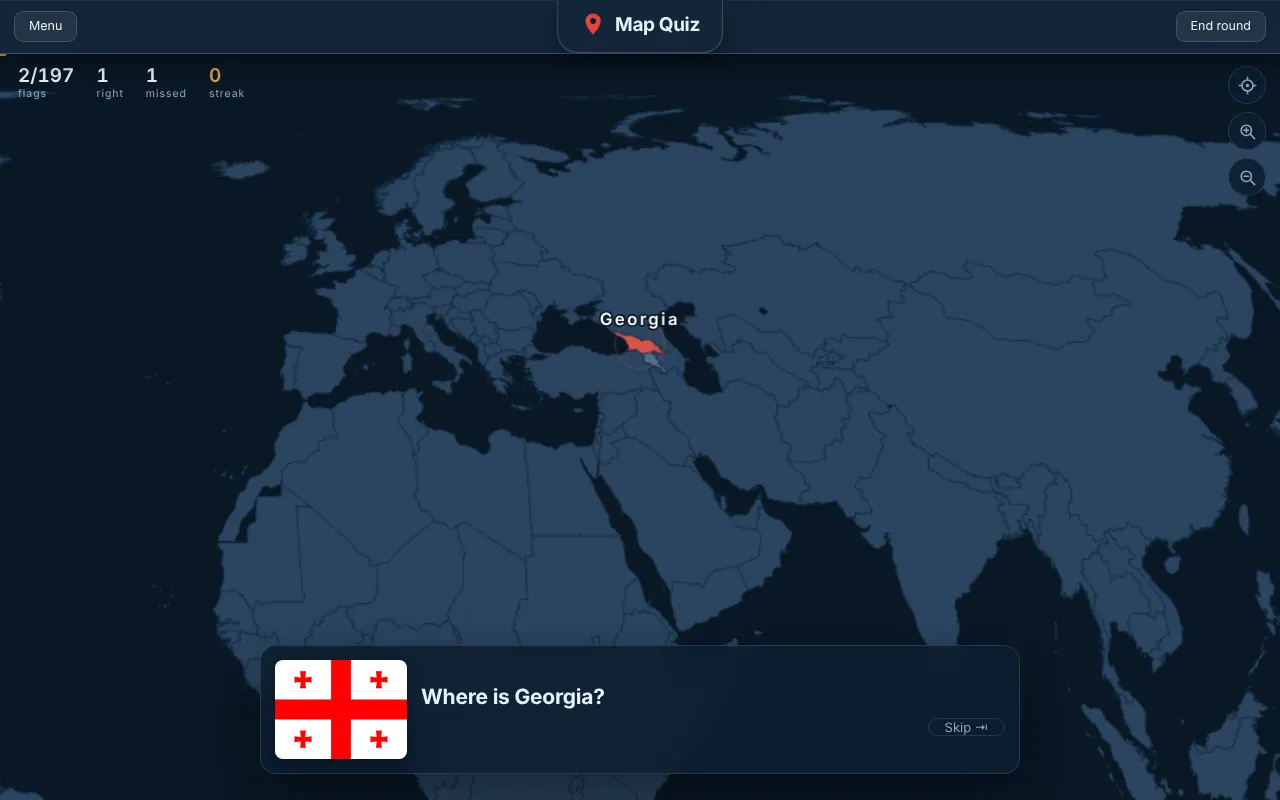 GameMap Quiz: how to playRules, scoring and tips.
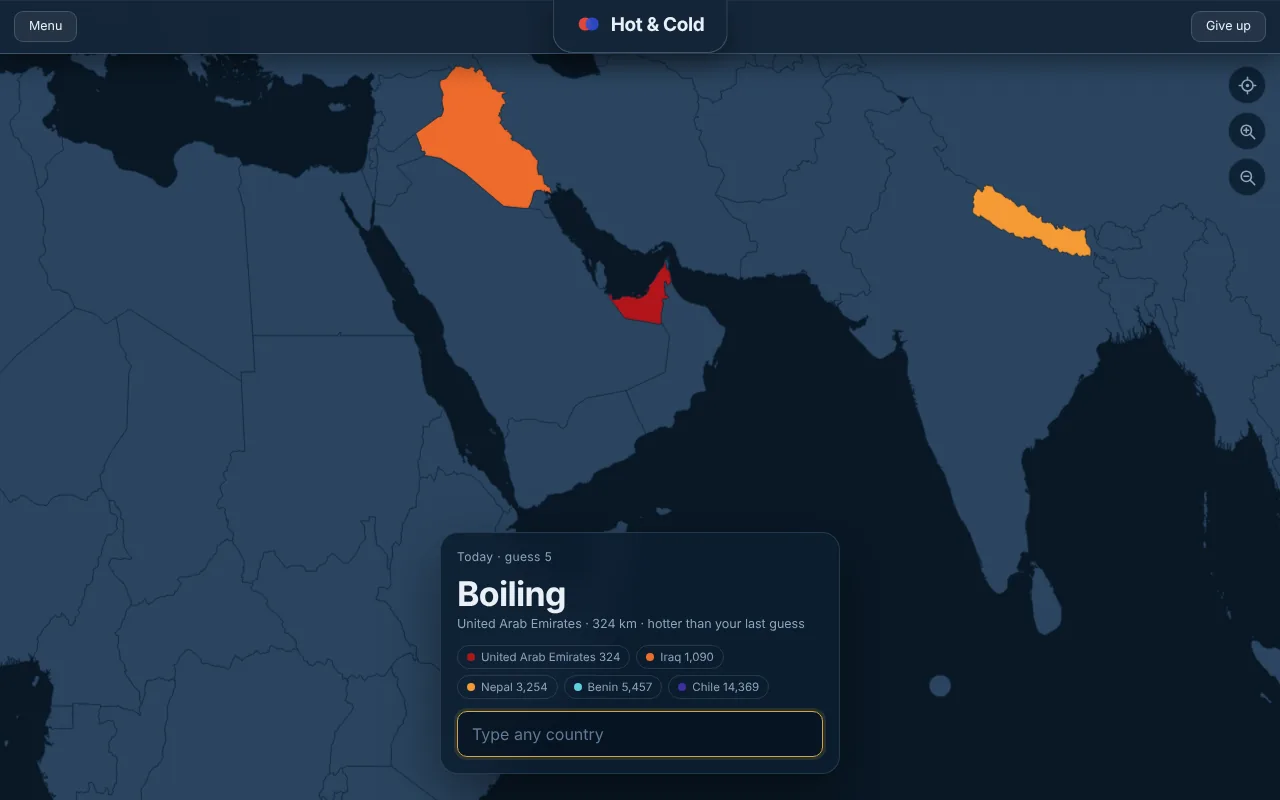 GameHot and Cold: how to playRules, scoring and tips.
More guides
 How it works · 6 min readHow Globely's daily puzzles workWhy everyone gets the same puzzle on the same day, and why a friend in Tokyo probably gets it before you.
 Countries · 6 min readThe countries that drive on the left, and how they ended up thereFifty-four countries drive on the left. That's a quarter of them, but about a third of the world's people.