The countries with no coastline, and why it matters so much
Forty-five of the 197 countries in Globely have no coast at all. Some lost theirs in a war, one lost it when a region became independent, and one still keeps a navy anyway.
Forty-five countries, four continents
The usual count is 44 landlocked sovereign countries. Globely also includes Kosovo, which has no coast either, so in the game it's 45. That's almost a quarter of all the countries.
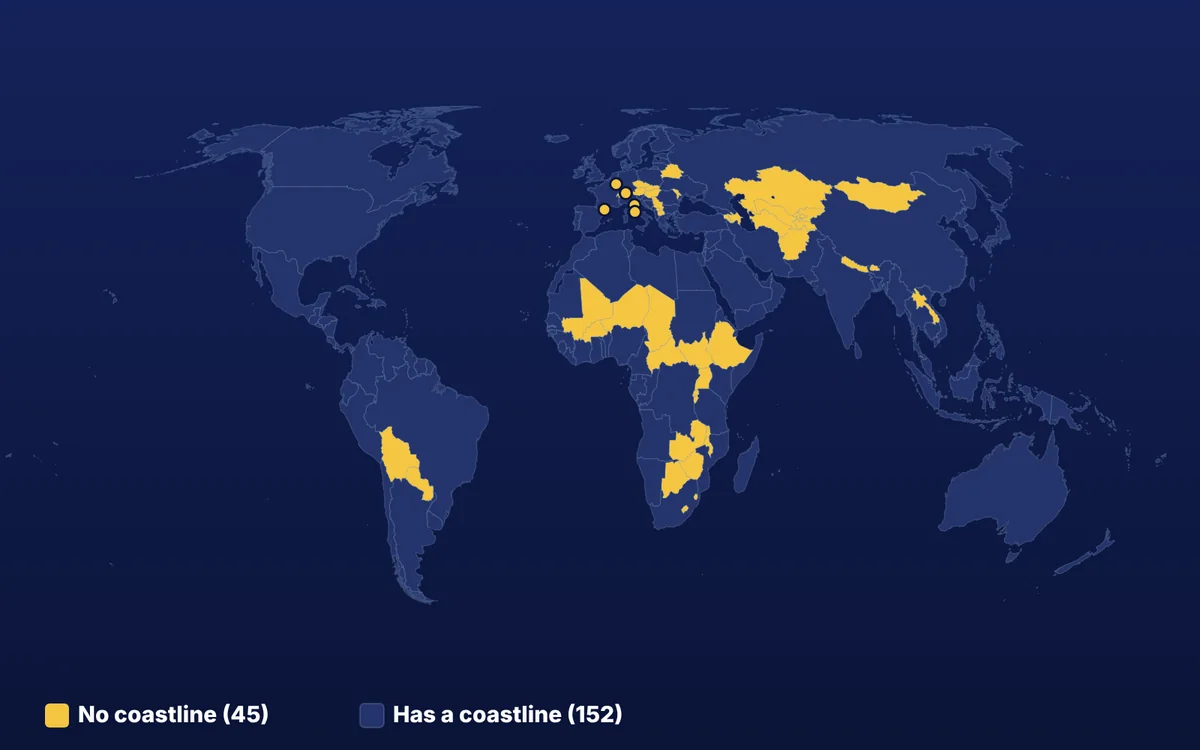
By region, using Globely's continents:
| Region | Landlocked | Examples |
|---|---|---|
| Africa | 16 | Mali, Niger, Chad, Ethiopia, Uganda, Zambia, Zimbabwe |
| Europe | 15 | Switzerland, Austria, Hungary, Czechia, Serbia, Belarus |
| Asia | 12 | Mongolia, Kazakhstan, Afghanistan, Nepal, Laos |
| Americas | 2 | Bolivia and Paraguay |
| Oceania | 0 |
The whole of North America, Central America and the Caribbean has zero, which kind of makes sense once you look at how thin Central America is. Oceania has zero too, because almost every country there is an island.
The map also shows a couple of patterns I find really useful for remembering them. There's a belt across Africa just south of the Sahara: Mali, Burkina Faso, Niger, Chad, the Central African Republic, South Sudan and Ethiopia. There's a block in southern Africa: Zambia, Zimbabwe, Botswana, Malawi and the two countries inside or almost inside South Africa, Lesotho and Eswatini. And there's a long chain through the middle of Asia, from the Caucasus through Central Asia to Mongolia.
The biggest and the most crowded
Using Globely's own area and population figures (the same ones Rank It uses):
| Biggest by area | km² | Most people | Population |
|---|---|---|---|
| Kazakhstan | 2,724,910 | Ethiopia | 132 million |
| Mongolia | 1,564,116 | Uganda | 50 million |
| Chad | 1,284,000 | Afghanistan | 43 million |
| Niger | 1,267,000 | Uzbekistan | 36 million |
| Mali | 1,240,192 | Nepal | 30 million |
Kazakhstan is the biggest by far (I wrote about it in the guide to the "-stan" countries), and Ethiopia has more people than any other landlocked country. Add up just the ones with population data in the game and you get more than half a billion people living in a country with no coast.
How you lose a coast
Some countries never had a coast. Others had one and lost it, and those are the stories I find most interesting.
Bolivia is the famous one. During the War of the Pacific, which started in 1879, Chile occupied Bolivia's coastal territory, and a peace treaty in 1904 recognised that land as Chilean "absolutely and in perpetuity". Bolivia never really accepted it. It took Chile to the International Court of Justice, and on 1 October 2018 the court ruled 12 to 3 that Chile had no legal obligation to negotiate sea access for Bolivia.
And here's the part I love: Bolivia still has a navy. It had about 5,000 personnel as of 2018, patrolling Lake Titicaca and the country's rivers, and every year Bolivia marks a Day of the Sea to repeat its claim. You can call that stubborn, but I think it's kind of admirable.
Ethiopia lost its coast in a different way. Eritrea, the strip of land along the Red Sea, became a sovereign country in 1993 after a war of independence that lasted almost three decades. Eritrea took the whole coastline with it, about 1,000 km of it, and Ethiopia, now with more than 130 million people, has been landlocked ever since.
South Sudan is the newest landlocked country. It became independent on 9 July 2011, and Sudan kept the Red Sea coast.
The Caspian question
Kazakhstan, Turkmenistan and Azerbaijan all have long shorelines on the Caspian Sea, so are they really landlocked? Yes, because the Caspian isn't connected to the ocean. Britannica calls it the world's largest inland body of water, with no natural outlet. You can sail across it, but you can't sail out of it. In Rank It's coastline category, Kazakhstan and Azerbaijan both get 0 km.
This also decides whether Uzbekistan is "doubly landlocked", meaning every one of its neighbours is landlocked too. I explain that, and the three countries completely surrounded by another country, in the neighbours guide.
Why it matters
Coming from Mexico, which has an ocean on each side and 9,330 km of coastline in Rank It's data (13th of the 130 countries there), I find it hard to even picture a country with none. Most of my favourite trips have ended at a beach.
Not having a coast sounds like a small thing until you look at trade. The UN office that works with these countries counts 32 landlocked developing countries, and its numbers are pretty striking. Kazakhstan's nearest coast is 3,750 km away. Using World Bank figures from 2014, exporting a container cost these countries $3,204 on average, against $1,268 for the countries they ship through. The UN estimates their development is about 20% lower than it would be with a coast.
There's an international rule to help. Under the UN Convention on the Law of the Sea, landlocked states "shall have the right of access to and from the sea", with freedom of transit through their neighbours. In practice, that still means depending on someone else's ports and roads, which is exactly why so many of these countries care so much about who their neighbours are.
Coasts you could easily miss
Some countries technically have a coast, but only just. These are the shortest coastlines in Rank It's data:
| Country | Coastline | Where |
|---|---|---|
| Bosnia and Herzegovina | 20 km | A small gap on the Adriatic, around the town of Neum |
| Jordan | 26 km | The tip of the Gulf of Aqaba, on the Red Sea |
| DR Congo | 37 km | The mouth of the Congo River, on the Atlantic |
| Slovenia | 47 km | A short stretch of the Adriatic, next to Italy |
| Iraq | 58 km | The top of the Persian Gulf |
DR Congo is the one that gets me. It's the second biggest country in Africa, and all of that land reaches the ocean through a coast shorter than a lot of city ring roads. If you ever see it on Globely's map, look for the tiny gap between Angola and its separate province of Cabinda, north of the river mouth. That gap is the whole coastline.
And then there's Mongolia, the second biggest landlocked country, which has only two neighbours: Russia and China. Anything shipped in or out of Mongolia by land or rail has to cross one of them.
Two numbers from the map
I checked who borders the most landlocked countries in Globely's data, and it's China, with eight: Afghanistan, Bhutan, Kazakhstan, Kyrgyzstan, Laos, Mongolia, Nepal and Tajikistan. And among landlocked countries, Austria stands out: five of its eight neighbours (Czechia, Slovakia, Hungary, Switzerland and Liechtenstein) have no coast either.
Tip for the games: in Rank It, whenever the category is coastline, any landlocked country goes straight to the bottom with 0 km. In Map Quiz, learn the African belt from Mali to Ethiopia as one shape: once you have it, the coastal countries around it get much easier to place.
Sources
- Globely's game data (the map and neighbours used in Map Quiz and Border Walk, and Rank It's area, population and coastline figures)
- Wikipedia: Landlocked country
- International Court of Justice: Summary of the Judgment of 1 October 2018 (Bolivia v. Chile)
- Wikipedia: Bolivian Navy
- Britannica: Eritrea
- Britannica: South Sudan
- Britannica: Caspian Sea
- UN-OHRLLS: About landlocked developing countries
- UN Convention on the Law of the Sea, Part X
The games in this guide
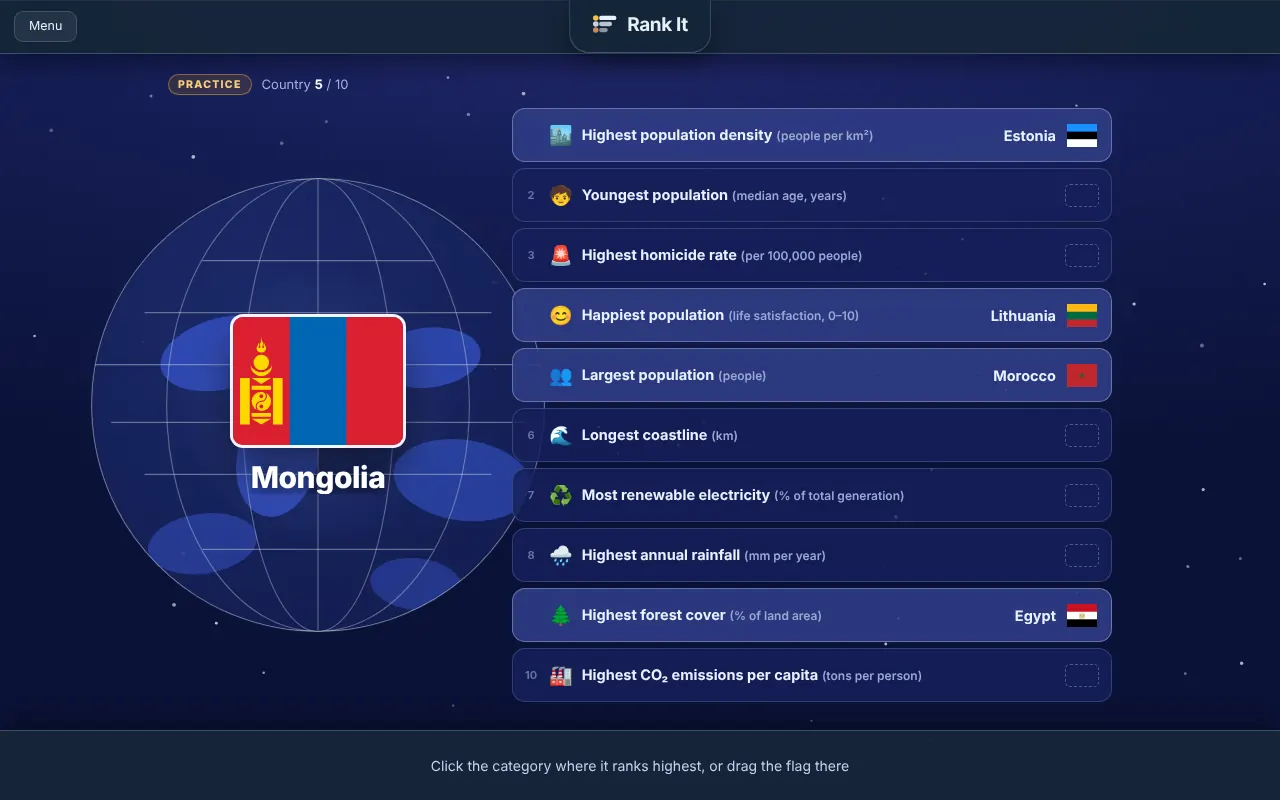 GameRank It: how to playRules, scoring and tips.
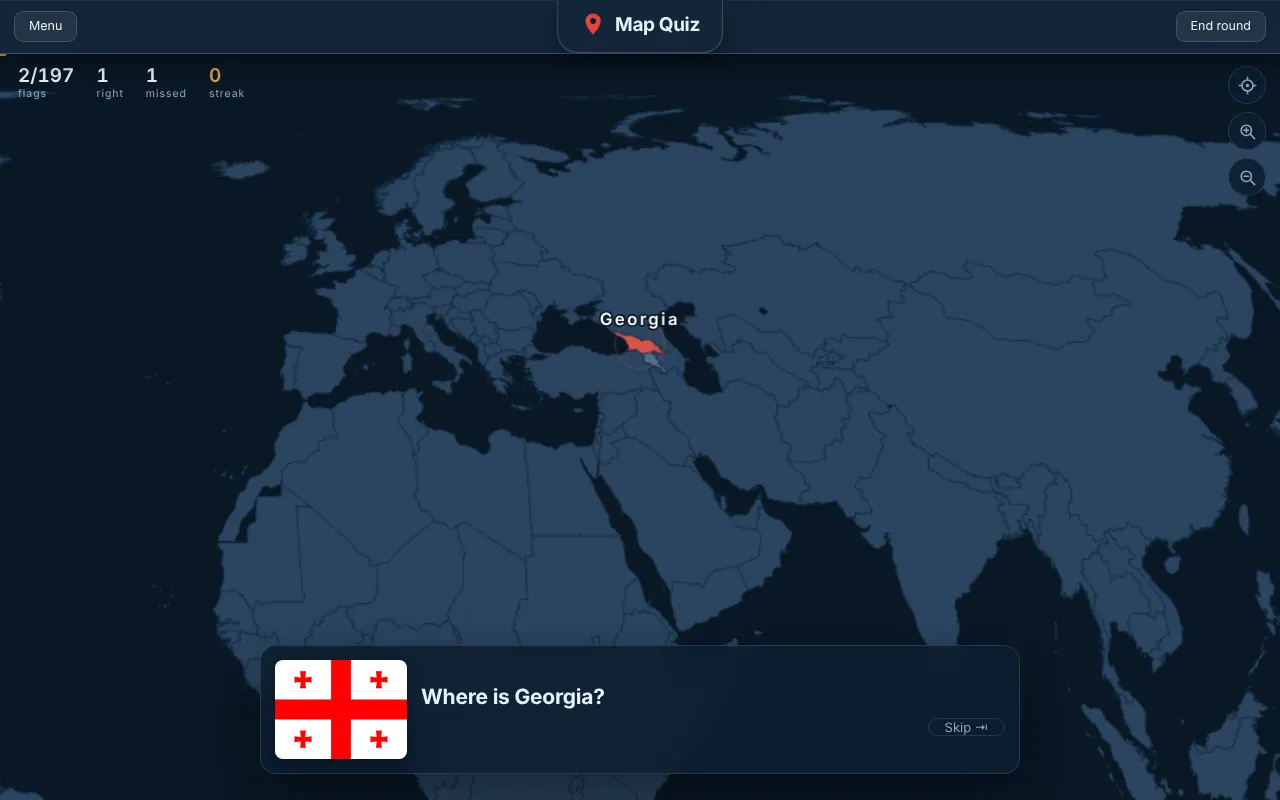 GameMap Quiz: how to playRules, scoring and tips.
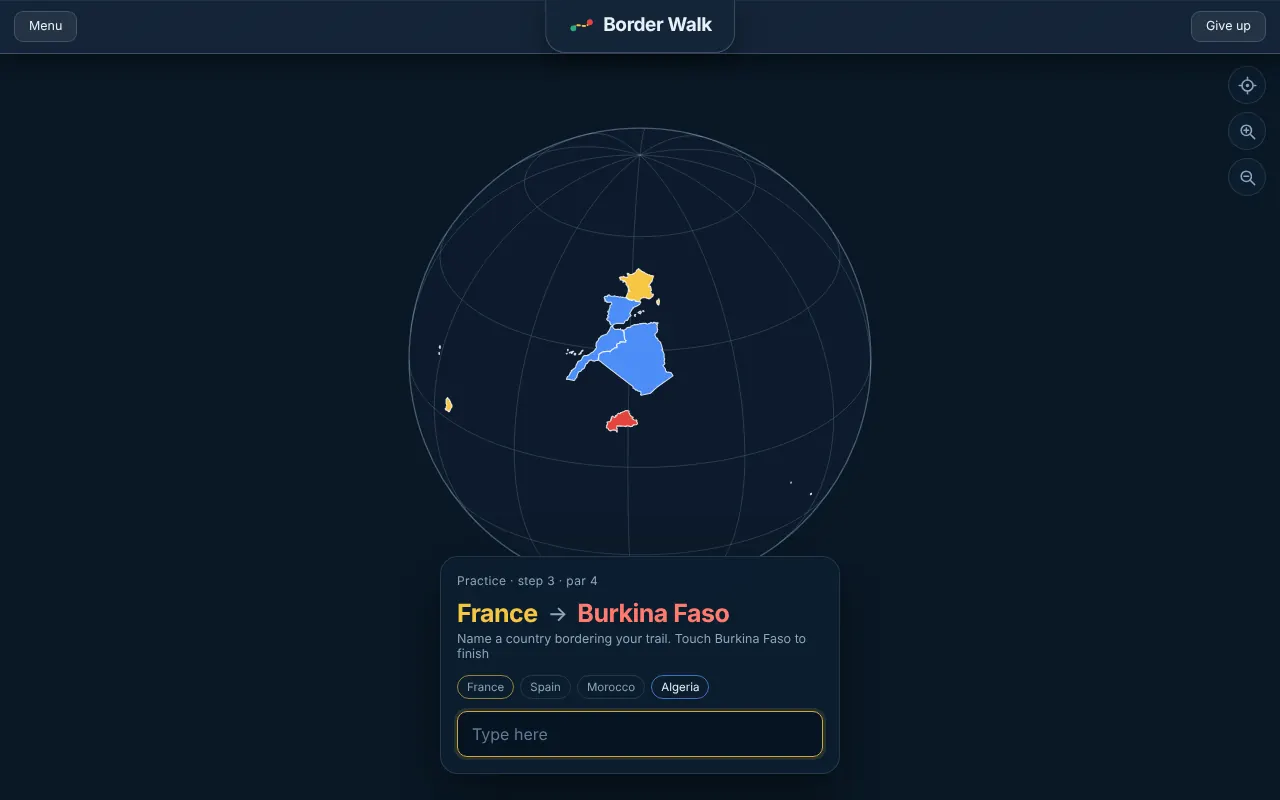 GameBorder Walk: how to playRules, scoring and tips.
More guides
 Maps · 6 min readWhich countries have the most neighbours?China and Russia touch 14 countries each. Seventeen countries only have one neighbour, and forty have none by land.
 Maps · 6 min readHow to tell the seven "-stan" countries apartSeven countries end in -stan, packed together like puzzle pieces. The details I use to keep each one straight.